

RBI Colloquium: "Unravelling Organic Reaction Mechanisms Using Ultrafast Spectroscopy and X-Ray Scattering"
We are pleased to invite you to the RBI Colloquium: Unravelling Organic Reaction Mechanisms Using Ultrafast Spectroscopy and X-Ray Scattering by Professor Andrew Orr-Ewing, FRS, Leverhulme Chair of Physical Chemistry, School of Chemistry, University of Bristol, United Kingdom. The lecture will take place on Monday, 5 October 2026 at 11 am in the 3rd Wing lecture hall.
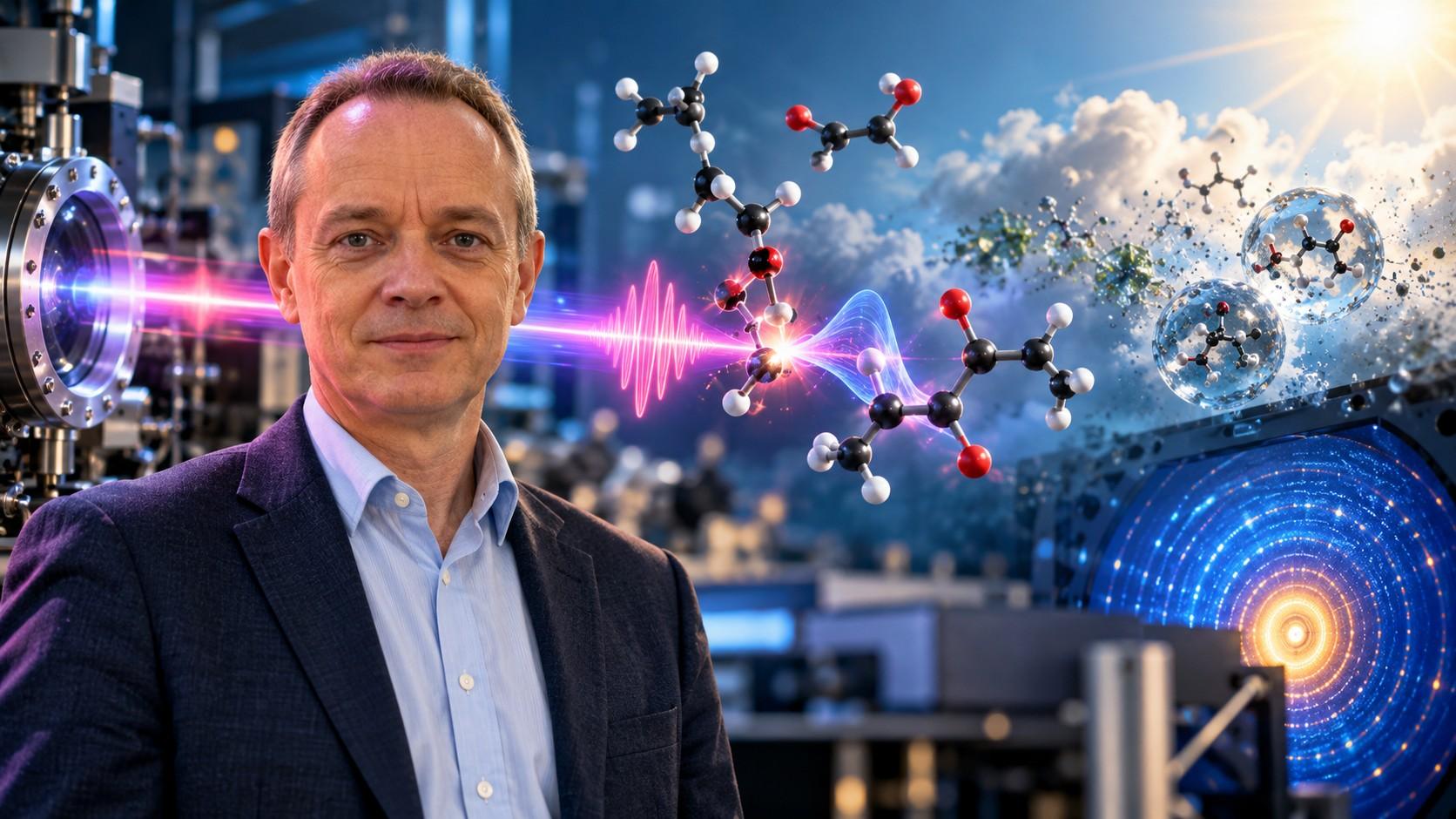
PROFESSOR ANDREW ORR-EWING, FRS
Leverhulme Chair of Physical Chemistry
School of Chemistry
University of Bristol
ABSTRACT
Activation of chemical reactions using light instead of heat offers an attractive route to improve the sustainability of chemical and materials synthesis. Outside the laboratory, sunlight plays a central role in driving the chemistry of Earth’s atmosphere and breaking down environmental pollutants. These various important photochemical processes have complicated mechanisms involving excited electronic states of the molecular chromophores, and the photochemical pathways are further influenced by the surroundings, for example because of interactions with solvent molecules. This talk will show how modern ultrafast spectroscopic and structural determination techniques, in combination with computational simulations, can unravel these complex photochemical pathways and provide profound mechanistic insights. Examples will include a photochemical Wolff rearrangement reaction important in organic synthesis, and the photochemistry of pyruvic acid which contributes to secondary organic aerosol formation in the atmosphere. New insights for photochemistry in aerosol microdroplets will be discussed.
BIOGRAPHY
Andrew Orr-Ewing is the Leverhulme Professor of Physical Chemistry at the University of Bristol. He obtained his BA and MA degrees in Chemistry and his doctorate in
Physical Chemistry from the University of Oxford, the latter under the supervision of Professor Gus Hancock. He then spent 2 years as a postdoctoral researcher with
Professor Richard Zare at Stanford University before returning to the UK to join the University of Bristol as a Royal Society Research Fellow. In more than 30 years at the University of Bristol, his group has conducted research in ultrafast chemical dynamics, organic photocatalysis, molecular spectroscopy, reaction dynamics and
kinetics, atmospheric chemistry and photochemistry, trace-gas sensing, and measurement of the optical properties of single aerosol particles. This work has been
supported by major grants from EPSRC, NERC, and the ERC. His research achievements have been recognized by his election as a Fellow of the Royal Society, a
Member of the Academia Europaea, a Foreign Fellow of the National Academy of Sciences of India, and an International Honorary Member of the American Academy
of Arts and Sciences, as well as numerous prizes from the Royal Society of Chemistry – most recently the 2026 RSC Faraday Lectureship Prize. Andrew was Head of Physical and Theoretical Chemistry at the University of Bristol for a total of 8 years, and has served as Executive and Senior Editor of the Journal of Physical Chemistry A since 2020.