

IRB Scientists Discover Molecular Scissors Essential for the First Hours of Embryonic Development
In the first hours of a vertebrate embryo’s life, everything may appear calm from the outside. But deep inside its cells, a race against time is underway. DNA must be copied continuously, cells divide at extraordinary speed, and a single protein obstacle in the wrong place can trigger a chain of damage capable of halting development. New research by scientists at the Ruđer Bošković Institute shows what happens when the system responsible for removing such obstacles in time fails.
DNA can be imagined as the molecular instruction manual for life, but it is not stored passively inside the cell. Proteins constantly read it, copy it, repair it and organise it: they briefly bind to DNA, carry out their task, and then detach. Sometimes, however, they become chemically attached to DNA and remain where they should not. This gives rise to lesions known as DNA-protein crosslinks. Although the term may sound complex, the problem itself is straightforward: a protein that should have left the DNA after completing its job remains stuck there, becoming an obstacle that interferes with the normal reading and copying of genetic information.
Such damage occurs in cells every day. If it is not removed in time, it can lead to DNA breaks, cell death and serious errors in genetic instructions, with consequences that may include tumour development, the loss of brain cells and premature ageing.
This is precisely the problem addressed by IRB scientists in a study published in Nucleic Acids Research. Using zebrafish as a model organism, they showed that the ACRC protein plays a key role as a protease — a kind of molecular scissors that removes protein obstacles from DNA. When this system fails, damage rapidly accumulates in the embryo, and zebrafish embryos cannot survive the first day of development.
Zebrafish reveal what happens when DNA clean-up fails
Zebrafish, small freshwater fish, are an important model in biomedical research because their transparent embryos develop rapidly and outside the mother’s body. This allows scientists to observe directly what happens during the first hours of development, when cells divide quickly and DNA is continuously being copied and repaired.
The researchers used this model to examine what happens when cells are unable to remove proteins trapped on DNA. Using the precise CRISPR-Cas gene-editing method, and after two years of modifying and breeding the fish, they created a new genetic line of zebrafish in which the part of the ACRC protein responsible for cutting away protein obstacles was damaged.
The results showed that embryos without a functional protective system could not survive the first day of development. However, when the researchers introduced instructions for producing the normal version of the protein into these embryos at the single-cell stage, development continued. The rescued embryos grew into adult and fertile fish, enabling the scientists to continue studying this mechanism.
“Our results show that this protective system is particularly important during the earliest stages of development, when cells divide very rapidly and DNA must be constantly copied and maintained. When the system does not work, protein obstacles on DNA quickly accumulate and the embryo cannot continue developing,” explains Dr Marta Popović, corresponding author of the paper and leader of the research.
Damage that accumulates before it becomes visible
One of the most striking parts of the study occurred six hours after fertilisation. Externally, the embryos still appeared normal, but serious damage was already accumulating inside their cells.
The study showed that when this system fails, different proteins begin to build up on DNA — proteins that normally perform essential roles, for example in DNA replication, gene expression, DNA repair and the regulation of cellular activity. In a healthy cell, these proteins are necessary. But when they remain trapped on DNA, they turn into obstacles known as DNA-protein crosslinks.
“This research shows that we are not talking about the removal of just one type of problem, but about a broader system that keeps DNA accessible and usable. When we rescued the embryos by introducing the normal version of the protein, the levels of key measured types of damage returned to levels comparable with those seen in normal embryos. This tells us that the consequences of disrupted DNA repair can begin to accumulate very early, before they become visible in the embryo’s appearance,” adds Dr Popović.
Why does this matter?
This is fundamental research, but it helps answer an important question: how do cells protect DNA while they are dividing and developing rapidly? This is especially important in the embryo, where a large number of new cells must be produced in a short period of time, while genetic instructions must remain readable and undamaged.
When proteins stick to DNA and are not removed in time, the cell can no longer use its genetic instructions properly. Such damage is associated with DNA breaks, cell death and diseases in which the stability of genetic material is compromised. A better understanding of this protective system may therefore support future research into cancer, infertility, ageing, neurodegeneration and other diseases linked to DNA damage.
Another important point is that this protein has been conserved throughout evolution in almost all vertebrates, including humans. The zebrafish and human versions of the protein share important common features, making zebrafish a valuable model for studying this mechanism. However, the study does not claim that every detail of this process is identical in humans. Rather, it shows how this system functions in a living organism during the early development of vertebrates.
Who is behind the research?
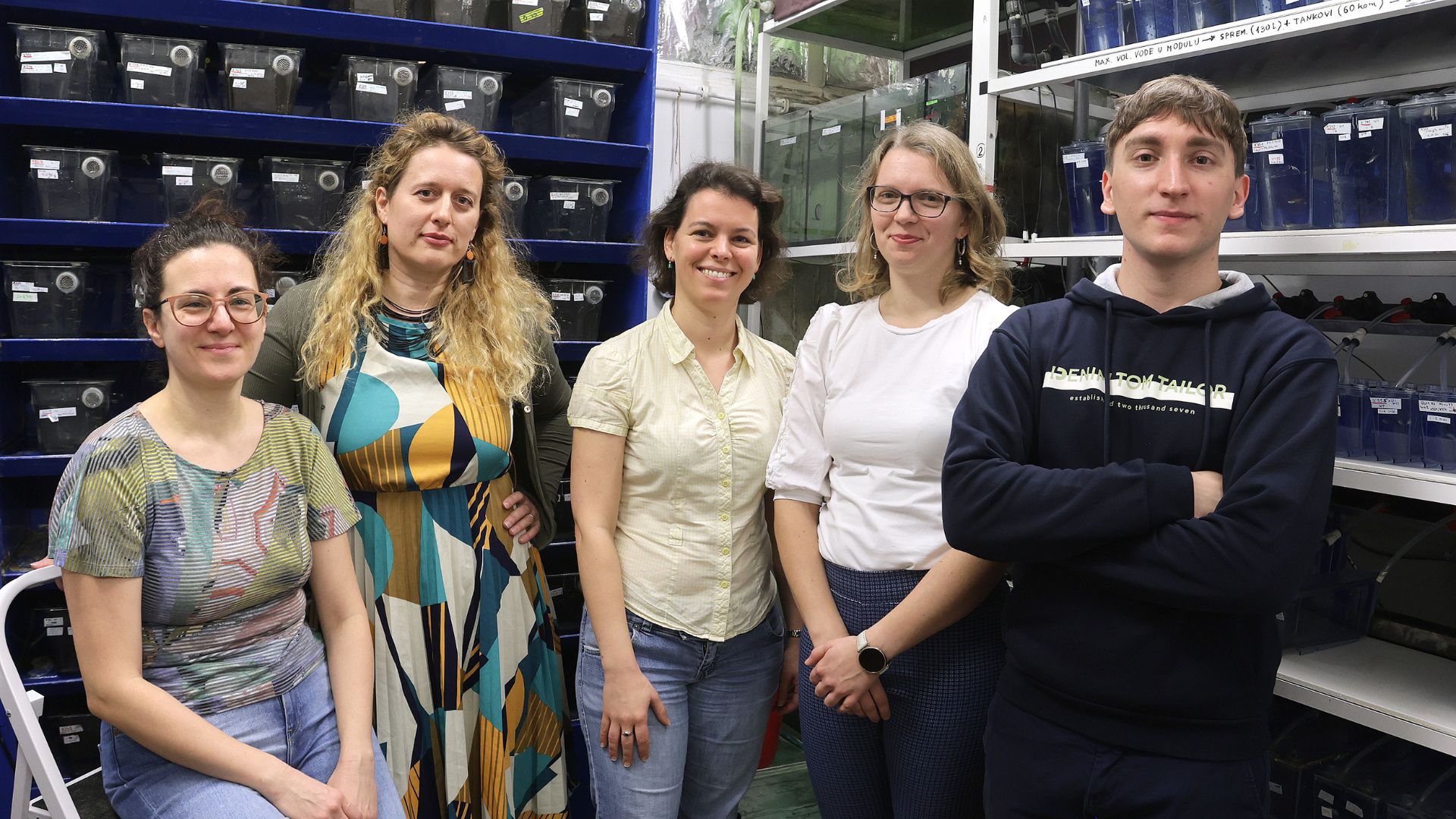
The research was carried out by Dr Cecile Otten, Marin Kutnjak, MSc in Molecular Biology, Dr Christine Supina-Pavić, Dr Marija Pranjić, Dr Ivan Antićević, Vanna Medved and Dr Marta Popović from the Division for Marine and Environmental Research at the Ruđer Bošković Institute in Zagreb. Dr Cecile Otten and Marin Kutnjak share first authorship, while the project leader and corresponding author of the paper is Dr Marta Popović.
The research was funded by the Croatian Science Foundation through the installation grant UIP-2017-05-5258 and project HRZZ-IP-2024-05-9425, the Slovenian-Croatian bilateral project IPS-2020-01-4225, and the European Structural and Investment Funds under the STIM-REI project, KK.01.1.1.01.0003. Open-access publication of the paper was funded through the European Union’s NextGenerationEU programme.
Contact Us
Read more

HRZZ