

International Robotics Conference: RBI Showcases Humanoid Robots and Drones in Action
At the Robot–Drone Demo Convoy, held on 12 September in Zadar and Kukljica, the Ruđer Bošković Institute (RBI) showcased its contribution to the development of humanoid and marine robotics, artificial intelligence, and the use of autonomous systems in marine research. Particular attention was drawn by the humanoid robots Joža and Tonka, whose capabilities were demonstrated by researchers from RBI’s Centre for Informatics and Computing.
The Robot–Drone Demo Convoy was the main demonstration event of the 5th International Conference on Robotics, MIPRO Robotics 2026: Robot Technologies and Applications (RTA), hosted by the University of Zadar. In real-world marine conditions, participants presented advanced solutions in underwater, aerial and terrestrial robotics, autonomous systems and artificial intelligence.
The RTA conference was organised by MIPRO, while the Ruđer Bošković Institute is one of the co-organisers of the 49th MIPRO Convention through its institutional membership.
From humanoid robots to marine research
At the Uskok Sailing Club, participants presented the MARBLE Centre of Excellence in Maritime Robotics and Technologies for Sustainable Blue Economy, as well as MULTI-STEM, a project aimed at promoting STEM through a multidisciplinary approach.
Following the convoy’s arrival in Kukljica, visitors were able to see the humanoid robots Joža and Tonka in action, alongside a robotic dog and a range of drones and autonomous vehicles designed for marine and underwater research. The demonstrations included technologies for seawater sampling, detecting submarine springs, close-range photogrammetry, bathymetric surveying and imaging of the marine environment.
Joža and Tonka attracted particular attention. Presented by researchers from RBI’s Centre for Informatics and Computing, the demonstration “Humanoid Robots: From Walking to Dancing” showcased their technological and kinematic capabilities, ranging from autonomous movement and interaction with visitors to performing a waltz together.
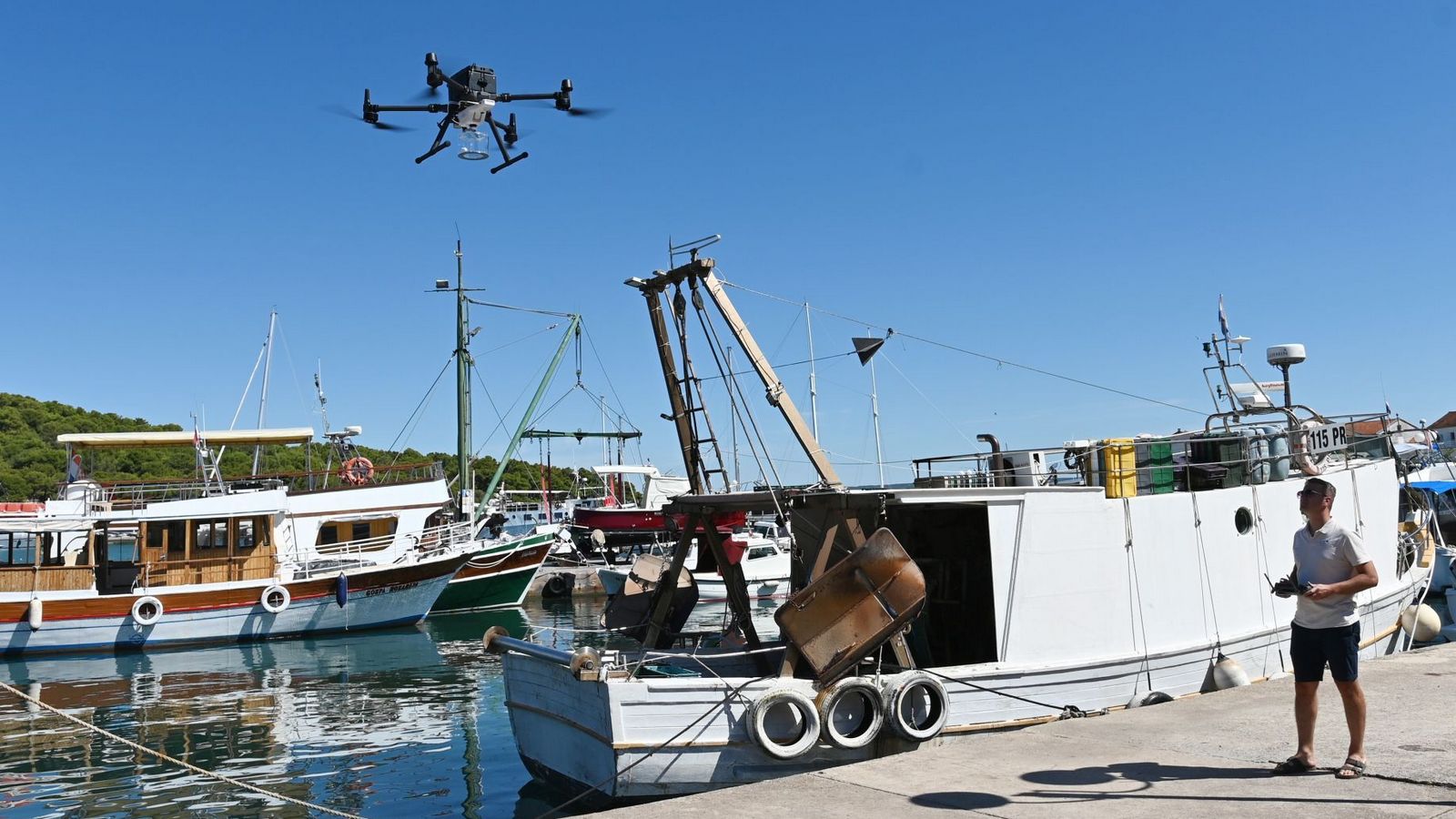
RBI also demonstrated how autonomous technologies can be applied in marine science. Dr Neven Cukrov of RBI’s Division for Marine and Environmental Research demonstrated seawater sampling using a drone, illustrating how robotic systems can enable scientists to collect data more quickly, safely and accurately, particularly in locations that are difficult to access.
The technologies presented are the result of work carried out through a series of European projects that contributed to the establishment of the MARBLE Centre of Excellence, of which RBI is a member. The Centre for Informatics and Computing is also a project partner in MULTI-STEM, which uses emerging technologies and hands-on demonstrations to bring robotics, computer science and other STEM fields closer to children and young people.

humanoidni roboti Joža i Tonka.
Three decades of connecting science, technology and the sea
The Robot–Drone Demo Convoy was also organised to mark the 30th anniversary of the ELMAR University Regatta, launched by RBI’s Centre for Informatics and Computing in 1996 and organised by the Centre until 2007.
From the first ELMAR Regatta to today’s Robot–Drone Demo Convoy, the Centre has continuously brought together computer science, advanced technologies, the marine environment and education.
The RTA conference was also held in Zadar to support the launch of a new university study programme in mechatronics and to encourage the development of industries focused on robotics, autonomous technologies and cooperative systems.
Artificial intelligence as both a tool and a societal challenge
The programme also included a public panel discussion on the development of robotics and artificial intelligence, their impact on the economy and everyday life, and the changes they are likely to bring to society in the future.
The discussion brought together Prof. Josip Faričić, Rector of the University of Zadar; Professor Emeritus Karolj Skala; Prof. Stjepan Bogdan of the Faculty of Electrical Engineering and Computing; Prof. Marko Valčić, Head of the Department of Mechatronics and Robotics at the University of Zadar; Dr Zorislav Šojat of RBI; Dr Katarina Đurić; Slavko Vidović, President of the Management Board of Infodom and President of the Smart Industry Association; innovator and entrepreneur Željko Goja; and manager Tadej Slapnik. The panel was moderated by Dr Ernest Vlačić.
Participants agreed that artificial intelligence opens up significant opportunities for science, education and the economy, but that its use must be accompanied by responsibility, critical thinking and a clear understanding of the potential for misuse. Dr Zorislav Šojat of RBI cautioned that increasing reliance on artificial intelligence will not, in itself, make people more intelligent or strengthen their ability to reason independently. Developing the knowledge and judgement required to use AI responsibly therefore remains essential.
The development of intelligent systems that move beyond computers and into the physical world of robotics brings new scientific, economic and societal challenges. At the same time, it creates opportunities for smaller countries such as Croatia to build a distinctive position in the development of technologies that will shape the future by investing in knowledge, research and collaboration.
Through its role in organising the RTA conference, its participation in European projects, the development of humanoid robotics, and the demonstration of autonomous systems in real-world environments, the Ruđer Bošković Institute and its Centre for Informatics and Computing continue to strengthen Croatia’s capabilities in artificial intelligence, robotics and advanced computing.