

Less is more, Ruđer scientists accelerated a photochemical reaction in a ball mill
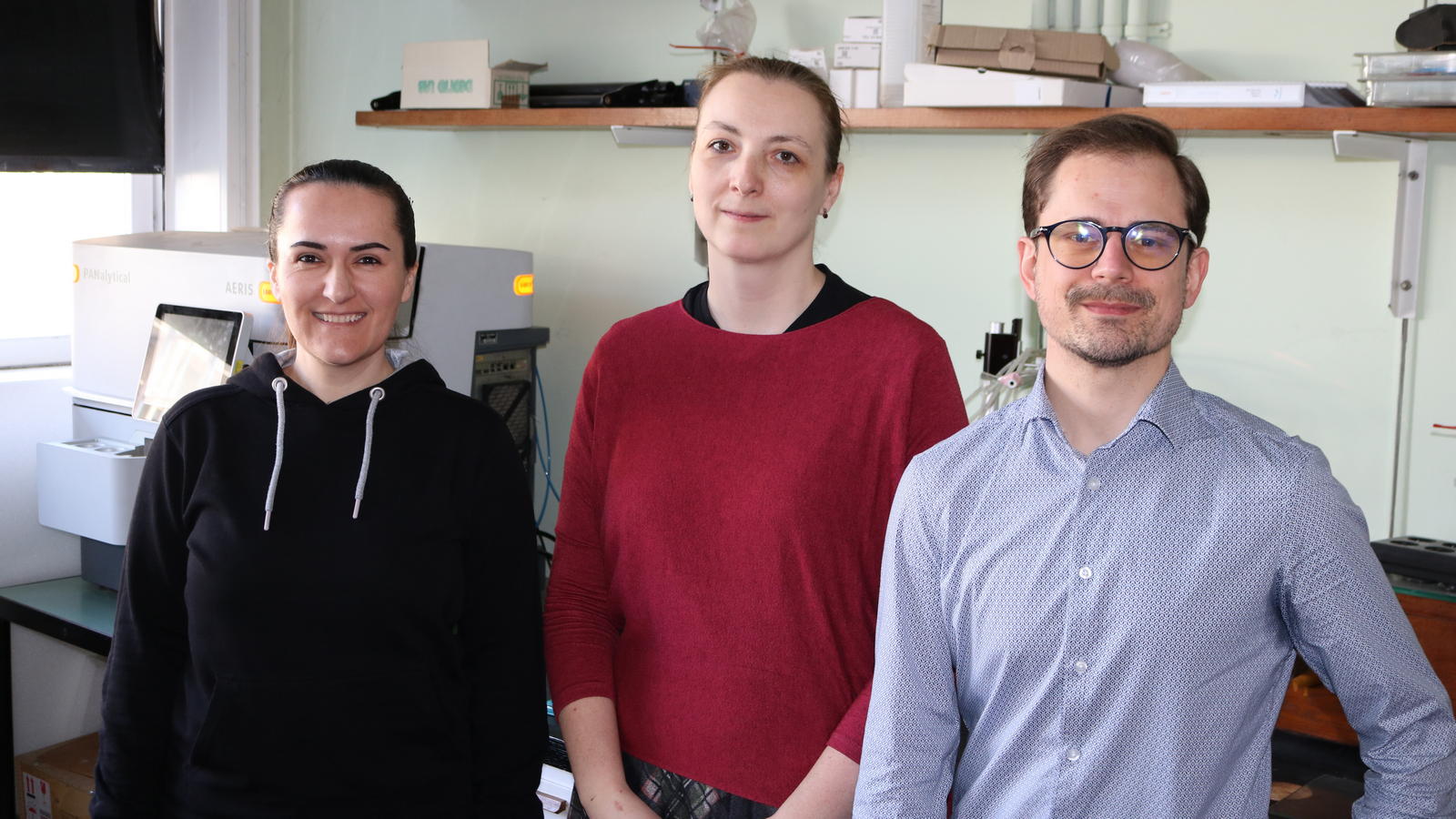
Senada Muratović, Marina Juribašić Kulcsár and Mario Pajić
Scientists at the Ruđer Bošković Institute, RBI, are the first to show that an important photochemical reaction can be carried out efficiently in a ball mill, a closed vessel in which powdered substances are continuously mixed and ground by the impact of a milling ball. The process runs continuously, without the use of solvents, and with a very small amount of an auxiliary substance that “helps” the molecules join together. The result points to a practical route toward processes that consume fewer resources and generate less waste, while also being easier to automate and reproduce, which is crucial when a laboratory procedure is to be turned into a reliable process, in science and in industry, for example in the development of new materials.
“For the first time, we carried out a photochemical dimerization, the joining of two identical molecules into one larger one, in a ball mill, and by monitoring the reaction in real time we observed interesting effects that, despite the large number of previous studies on this topic, had not previously been recorded in this system. Our method was precisely what enabled us to study and explain these phenomena in detail. In addition, the process is almost ten times faster than previously published approaches and takes place without the use of solvents, literally ‘just’ by grinding two solid substances, one of which is used in a catalytic amount. Because of this, the process fully complies with the principles of green chemistry,” explains Dr Marina Juribašić Kulcsár, the corresponding author of the paper.
The paper was published in the prestigious international journal Chemical Communications, published by the Royal Society of Chemistry, and the research was carried out entirely by scientists from the Ruđer Bošković Institute in Zagreb. Alongside Dr Juribašić Kulcsár, the team includes Dr Mario Pajić and Dr Senada Muratović. The computer simulations that helped explain the results were performed on the Supek supercomputer at the University Computing Centre, SRCE, in Zagreb.
Light, balls and the “smart arrangement” of molecules
Many chemical processes use large amounts of solvents and additives that must ultimately be disposed of. Here, the approach is different: the reaction takes place in a solid mixture, in a ball mill, where the powder is continuously mixed and ground while at the same time being illuminated by LED sources. This kind of mechanical mixing combined with light continuously exposes new material surfaces, which helps the reaction proceed faster and more evenly.
In a solid mixture, molecules do not move freely as they do in a liquid, so they must “find” each other at very close range and in the right position in order to combine. This is where resorcinol helps, a small organic molecule that acts in the mixture as a kind of “organizer”, temporarily directing the molecules into a position favorable for joining under light.
How was this done before, and why was it problematic?
Although this reaction has been studied for decades, in practice it was often carried out in ways that were difficult to standardize. Mixtures were stirred manually, in a mortar or in simpler devices, and the procedure could last from several hours to several days. Manual mixing is especially problematic because the result depends on the person performing it, while at the same time mixing and illuminating continuously is not easy to achieve without interruption. An additional challenge was monitoring. To check the course of the process, researchers had to stop the procedure, take a sample, and analyze it, which introduced pauses and reduced reproducibility.
Monitoring the reaction “live”
In the new approach, the mill operates continuously and the sample is illuminated without interruption. A special advantage is that the authors monitored the course of the reaction using an analytical method, Raman spectroscopy, in real time, without stopping the mill. This gave them a clearer insight into what was happening in the mixture throughout the entire process, rather than only at the end.
Key finding, the optimal amount of template
The team systematically compared different amounts of resorcinol and showed that “more” does not necessarily mean “faster”. The fastest course was achieved when the amount of resorcinol was relatively low, approximately from one tenth to one half relative to the starting material, 10–50 mol%, and the best result was achieved at about one quarter, 25 mol%. Resorcinol does not “disappear” immediately: according to the measurements and computer simulations, it binds temporarily to the starting molecules, helps them join, and can then detach and take part again in the next step, like an assistant that is reused multiple times during the process.
“Computer simulations and measurements indicate that resorcinol most readily forms a stable pair with the starting molecule, and after the product is formed it can bind again with the remaining starting material, enabling a cycle in which resorcinol is practically ‘recycled’ during the process,” explains Dr Mario Pajić, the first author of the paper.
“In this research, we used a new system for photochemical reactions that we developed and built in house at RBI a year ago. The method development was led by Dr Ivan Halasz, and the construction and implementation of the system involved Dr Ivica Cvrtila, research associate in our laboratory, Ivan Kulcsar, mechanical engineering graduate, senior professional associate in our laboratory, and Tomislav Mrla, senior technician at the Division of Physical Chemistry, with the use of the resources of the RBI Workshop. This new system is a valuable result of cooperation among people from different professions working at RBI,” emphasizes Dr Marina Juribašić Kulcsár.
Why is this important?
These results show that reactions can be carried out faster, more simply, and with less waste, without solvents and with a minimal amount of auxiliary substance. In addition, the procedure is more reproducible because it runs continuously and allows “live” monitoring, which makes optimization and future automation easier. This approach opens the way to more efficient production of chemical “building blocks” important for the development of new materials, and in the long term for applications in other fields as well, including pharmaceuticals.
The research was funded by the Croatian Science Foundation, IP-2019-04-9951, IP-2020-02-1419, DOK-2020-01-7515, and the computational part was carried out on the Supek supercomputer at SRCE. Further research is funded by the Croatian Science Foundation, IP-2025-02-3843.
Contact Us
Read more