

RBI Showcases Technology with Applications in Advanced Batteries, High-Sensitivity Sensors, Space Systems and Fusion Reactors
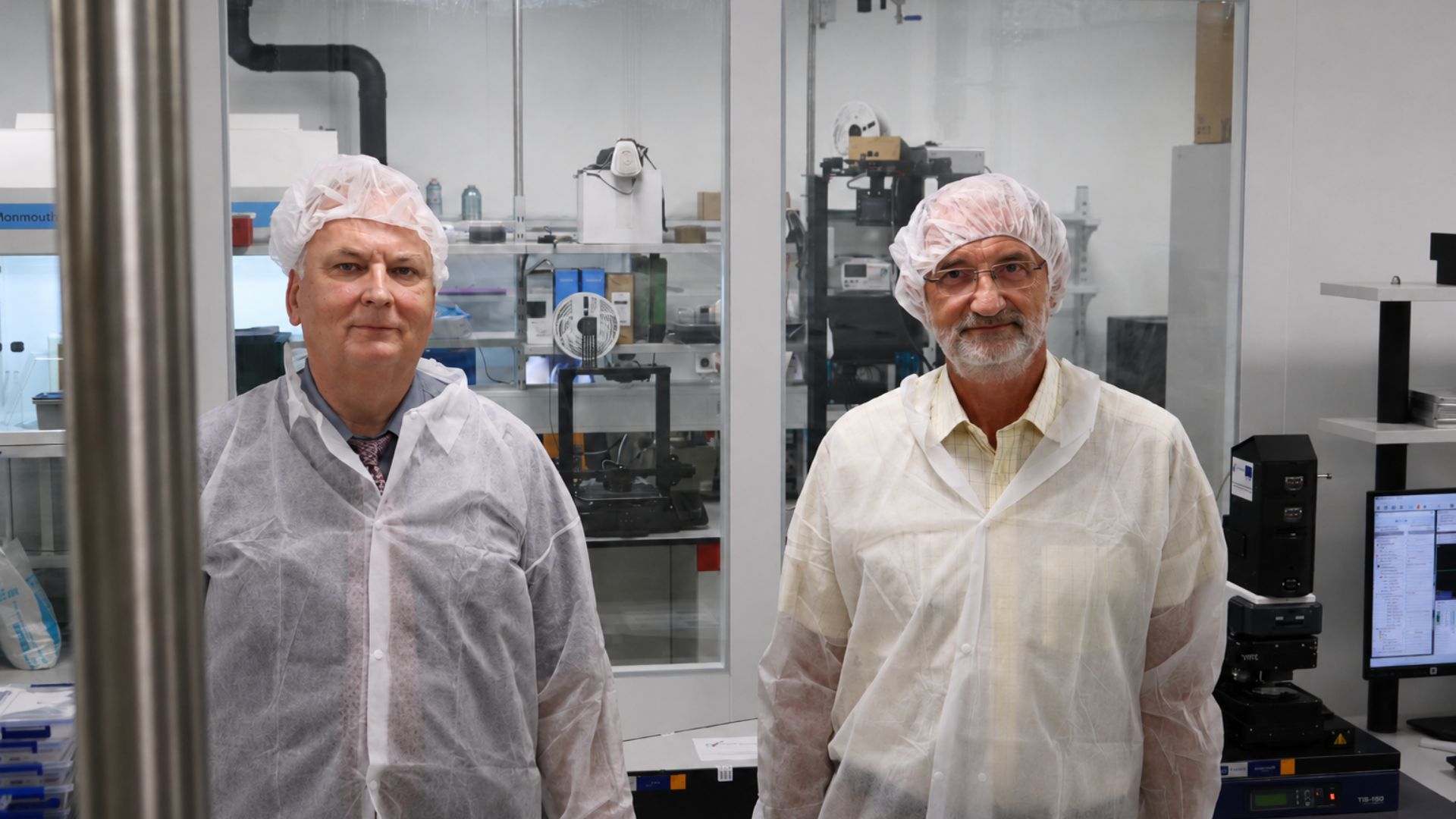
Dr Mile Ivanda and Dr Milko Jakšić in the cleanroom at RBI
The Ruđer Bošković Institute (RBI) today presented the research infrastructure, results and technologies developed within the Centre of Excellence for Advanced Materials and Sensors (CEMS) as part of its Industry Day. RBI leads the Centre in partnership with the Institute of Physics.
Companies, partners and media representatives were introduced to the potential applications of the technologies developed within the Centre, as well as various models of cooperation with industry and international research teams. For the first time, media representatives were also given access to the new cleanroom for research and development in semiconductor materials and components. A cleanroom is a specially designed, highly controlled enclosed environment in which the concentration of airborne particles, including dust, microorganisms and chemical vapours, is maintained within strictly defined limits. These conditions enable highly precise research and the production of elements that are sensitive to even the smallest levels of contamination, including semiconductor components, sensors, photonic elements, advanced materials and components for emerging technologies.
Hydrogen sensor important for safety in transport and industry
“Our work is moving in two directions. The first is cooperation with companies that require our technologies, components and services, while the second is the development of our own innovative solutions and products for specific niches in the global market. We have already developed one such high-technology product and expect it to reach the market more widely. In addition, we have developed a hydrogen sensor at RBI with very good performance characteristics. Reliable detection of possible hydrogen leaks is important for safety, the prevention of losses and environmental protection, particularly given the growing use of hydrogen technologies in industry and public transport. We expect to continue cooperating with companies on the application of this sensor,” said Dr Mile Ivanda, Head of the Laboratory for Molecular Physics and Synthesis of New Materials at RBI, where the cleanroom is located.
Methods for detecting microplastics in water
In cooperation with a Croatian company, the team used the cleanroom facilities to carry out research into and detect microplastics in water, one of the company’s products. According to Dr Ivanda, the results indicate that we can be satisfied with the quality of the water we drink. The cleanroom covers an area of 120 square metres and consists of three separate sections with different levels of cleanliness: a sample preparation area, an area for the deposition of thin material layers, and the cleanest section, which is used for photolithography. Photolithography is a process used to create extremely small structures on surfaces for the production of semiconductor components. The investment in the facility amounted to approximately €800,000, while the equipment installed in it is worth around €2.2 million.
From quantum communication to more energy-efficient electronics
The cleanroom is only one part of the wider infrastructure of the Centre of Excellence for Advanced Materials and Sensors, which has been operating for almost ten years.
A total of €6.5 million was secured through structural funds, primarily for human resources development, while the research units further expanded their infrastructure through other European and national projects, as well as private investment. “In addition to the €6.5 million secured for the Centre of Excellence, the research units invested further in infrastructure through other European and national projects. We estimate that investment in equipment was approximately four times greater than the investment in the Centre itself. This enabled us to reach a very high level of technological capability and significantly strengthen our capacity for cooperation with industry,” said Dr Milko Jakšić, coordinator of the Centre’s activities at RBI.
Three of the Centre’s research units based at RBI presented their work at the event: Physics and Technology of Ion Beams, New Functional Materials, and Photonics and Quantum Optics. The Institute of Physics presented the Graphene and 2D Structures research unit.
The programme included presentations on radiation detection technology, the development of quantum centres, the testing of materials for fusion reactors and space applications, sensors and Raman spectroscopy, energy-efficient electronics, photodetectors, and quantum communication infrastructure.
“The different research groups within the Centre complement one another. While some develop sensors, others develop the electronic components required for those sensors to function. It is precisely this combination of expertise and infrastructure that creates added value for research and cooperation with companies. In addition, more than 20 doctoral theses have been completed within these four research units in recent years. The teams have also expanded to include international researchers, while approximately 20 to 30 per cent of staff are funded through projects, mainly European projects,” Dr Jakšić said.
Research infrastructure available to companies developing new products
Cooperation with companies is already taking place through the use of ion beams to test the radiation resistance of materials.
“Research groups and companies from abroad come to RBI to use irradiation to test materials intended for fusion power plants and space technologies. The aim is to determine how these materials withstand the conditions to which they will be exposed in space or inside a fusion reactor. This is commercial cooperation provided through radiation and materials-testing services,” explained Dr Milko Jakšić.
RBI’s Industry Day was organised to give companies and institutions a clearer understanding of the opportunities available to them, including access to the Centre’s research equipment, the joint development of technologies and products, and the transfer of knowledge from the laboratory into practical applications.
The event was attended by representatives of numerous companies, including Mikatron Automatika, Odašiljači i veze, CEI Mikroelektronika, Elektrokem Industrial Electronics, Jamnica, Rimac Technology, IONIC, Protostar Labs, Femto, DELTAsort Robotics, ORQA FPV and Indeloop, as well as representatives of academic, public-sector and research institutions. On behalf of the City of Zagreb, participants were welcomed by Ivana Novak, representative of the Mayor of Zagreb and Assistant Head of the City Office for Economy, Environmental Sustainability and Strategic Planning.
Dr Ivanka Jerić, Assistant Director of RBI, thanked the Ministry of Science, Education and Youth, the Ministry of Regional Development and EU Funds, the City of Zagreb, the Institute of Physics, and all partners and collaborators who supported the development of the infrastructure. She emphasised that the new infrastructure would play an important role in strengthening RBI’s cooperation with companies and in supporting the development of high-value technologies and products.
The Centre of Excellence for Advanced Materials and Sensors focuses on the research and development of new materials, sensors, photonic and quantum technologies, and advanced research methods with potential applications in science, industry and the public sector. The Centre is led by the Ruđer Bošković Institute in partnership with the Institute of Physics. The project was co-funded by the European Union through the European Regional Development Fund.
