

A New Computational Model Reveals the Hidden Life of the World’s Largest Sea Turtle
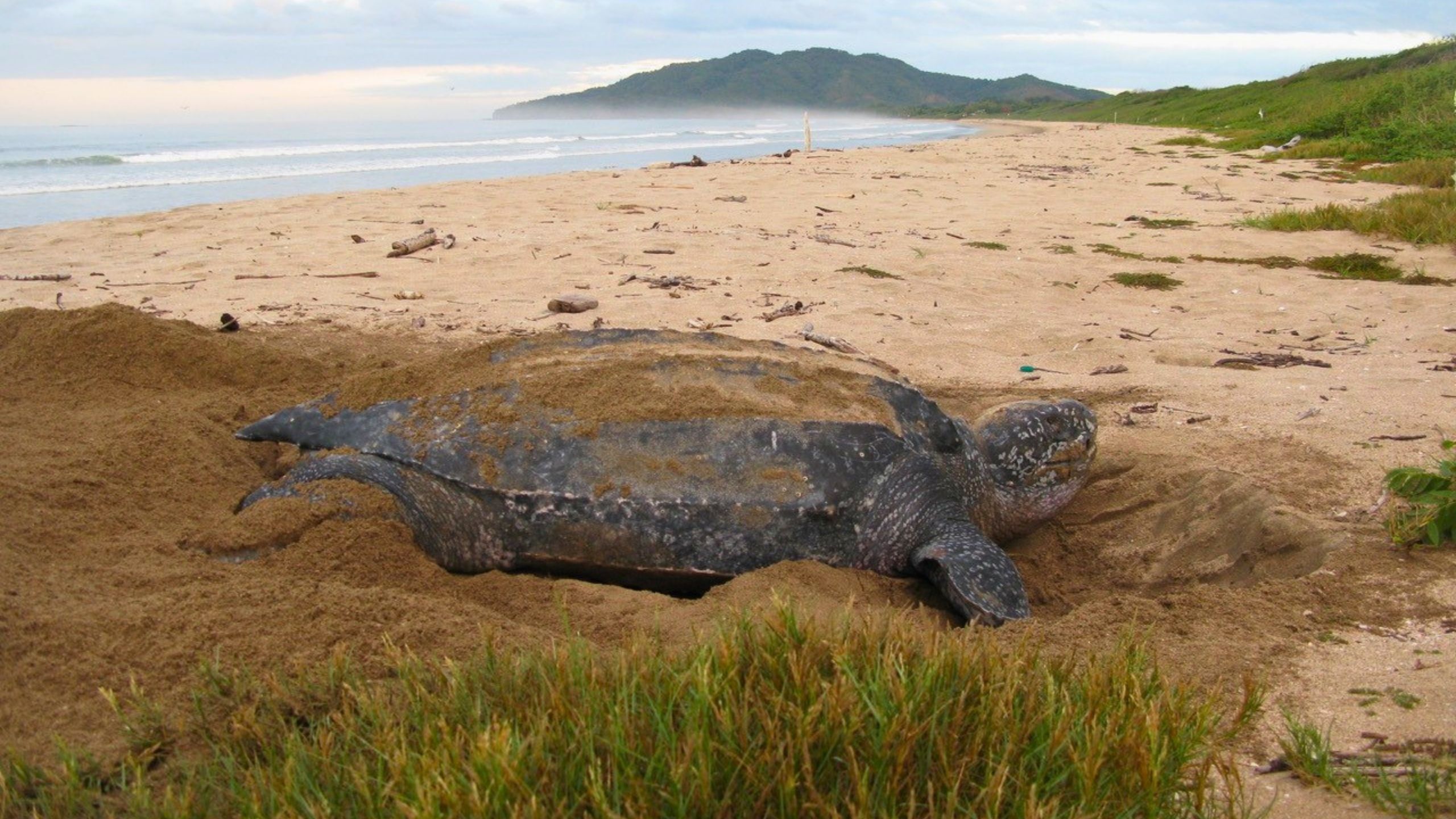
Photo: George Shillinger
What happens to the world’s largest sea turtle during the 15 to 20 years it spends far from shore, beyond the reach of scientists’ eyes? That is precisely the question addressed by a new study led by Dr. Nina Marn of the Ruđer Bošković Institute and an international team of collaborators. Published in Marine Environmental Research, the study presents a computational model that, for the first time, reconstructs the entire life cycle of the leatherback sea turtle and reveals just how sensitive this species is to changes in the ocean.
The model is based on general metabolic theory, specifically Dynamic Energy Budget (DEB) theory, and demonstrates how strongly these turtles respond to environmental conditions. Simulations suggest that even relatively small changes, such as reduced food availability and slightly warmer seas, can have long-term effects on growth, maturation, and the number of offspring this species produces over its lifetime. At a time of accelerating climate change and mounting pressure on marine ecosystems, such insights are crucial for understanding the risks faced by migratory marine species.
Why is the leatherback sea turtle so difficult to study?
Leatherback sea turtles, like other marine turtles, spend most of their lives out of sight. A hatchling emerges from its nest on the beach, enters the ocean, and then, for the next fifteen to twenty years, very little is known about its life. Only when an adult female returns to shore to lay eggs does she once again become accessible to scientific observation. These two moments in a turtle’s life are often almost all biologists have to work with, while the two decades in between unfold in the open ocean. Although the Adriatic is one of the most important foraging grounds for some sea turtle species, such as the loggerhead, the leatherback is only a very rare visitor to our waters and generally inhabits the vast expanses of the open ocean.
Adult females can weigh up to 400 kilograms, cross entire oceans, and dive to depths greater than one thousand metres. Unlike some sea turtle species that feed in coastal waters, leatherbacks approach the shore only during the nesting season. They feed primarily on jellyfish, prey that provides relatively little energy. In order to reproduce at all, they must spend years accumulating enough energy from this nutritionally poor food source.
For biologists, the challenge lies not only in the animals’ size or the distances they travel, but also in the fact that growth, maturation, and the accumulation of energy reserves—the most critical phases of their lives—take place in the open ocean, where direct observation is extremely difficult. To date, most data have come from short-term captive rearing of young turtles and from nesting beaches used by adult females, while the gap between these two life stages has remained substantial.
What is the DEB model and how does it work?
The DEB model, or Dynamic Energy Budget model, is a computational framework that describes how an organism obtains energy from food and allocates it to key life processes: body maintenance, growth, maturation, and, in adulthood, reproduction. Sea temperature can either accelerate or slow these processes. Once the species’ core physiological parameters are known, the model can simulate its entire life cycle under different environmental conditions.
This research is a strong example of global scientific collaboration. Alongside Dr. Marn, the authors of the paper are Dr. Anna A. Ortega and Dr. Nicola Mitchell from the University of Western Australia, Dr. Jeanette Wyneken from Florida Atlantic University, and Dr. George Shillinger from the organisation Upwell Turtles.
The model was calibrated using data from the northwestern Atlantic population, for which the most extensive dataset exists thanks to the unique work of Dr. Wyneken of Florida Atlantic University. She is one of the few researchers in the world who has successfully raised young sea turtles for life beyond the aquarium using a specially adapted diet and a custom-designed harness that prevents hatchlings from colliding with the glass walls of the tank. Her unpublished data on juvenile turtle growth, combined with fertility data from northwestern Atlantic nesting sites, made it possible to parameterise the model.
The range of environmental conditions included in the simulations was selected in consultation with Dr. Shillinger, a world-leading expert on this species. The research itself was carried out by Dr. Marn and Anna Ortega, a doctoral student of Dr. Mitchell, together with Dr. Shillinger of the US-based organisation Upwell Turtles.
“DEB models can be thought of as finely tuned calculators,” said Dr. Nina Marn. “You adjust food availability and sea temperature in the model, and then track what happens to body size, maturation time, and egg production across the turtle’s entire life.”

What did the simulations reveal?
The simulations showed that turtles require at least around 85 percent of the average food availability in their environment in order to reach sexual maturity at all. Below that threshold, they fail to accumulate enough energy to transition into adulthood and do not reproduce. This points to a very narrow margin for survival, in which even small environmental changes can have major consequences.
The model also shows that more abundant food and more favourable thermal conditions can generally lead to earlier maturation, larger body size, and greater reproductive potential. However, this relationship is neither simple nor linear. Temperature and food availability act together: warmer water may accelerate metabolism and development, but if food is scarce, that acceleration does not necessarily translate into greater growth or improved reproduction. This is precisely why the model offers valuable insight into scenarios that cannot be directly tested in nature.
Two oceans, one species
A particularly important insight emerged when the same model, using the same physiological parameters, was applied to the eastern Pacific population, which is critically endangered. In other words, the model tested whether many of the differences between Atlantic and Pacific leatherbacks could be explained by environmental conditions rather than by differences in the species’ underlying physiology.
The results indicate that a reduction in food availability of only around 5 percent, combined with seas that are on average 1°C warmer, could explain a large part of the observed differences between the two populations. According to the simulations, Pacific turtles mature slightly earlier and at a similar size, but grow less after maturation, reach a smaller final body size, and produce around 19 percent fewer eggs over the course of their lives.
“A difference of nearly one-fifth in total lifetime offspring is particularly insidious because it is difficult to detect in the short term,” explained Dr. Nina Marn. “In a single nesting season, a Pacific female may lay a similar number of eggs to an Atlantic one, but the difference only becomes apparent when the entire life cycle is considered—and that is exactly what this model allows us to do.”
Why does this matter for species conservation?
Leatherback sea turtles face serious pressures worldwide, and several of their populations continue to decline despite decades of conservation efforts. Because their migrations span entire ocean basins, they are exposed to numerous threats along the way. These include accidental capture in fishing gear, loss of nesting habitats, changes in sea temperature and food availability linked to climate change, and the growing presence of microplastics in the ocean, which these gentle giants often mistake for food.
The value of the model lies not only in its ability to explain differences that are already being observed, but also in its capacity to assess future scenarios. If ocean temperatures continue to rise while food availability declines, the model can help identify the conditions under which individuals are no longer able to mature or experience a significant loss in reproductive potential—changes that could ultimately threaten entire populations.
These are not rough estimates, but calculations grounded in the known physiology of the species, available empirical data, and clearly defined environmental scenarios.
A step towards understanding migratory species
All data and model code have been made publicly available through the Add-my-Pet database, enabling other researchers to use, test, and further develop the model—not only for leatherbacks, but also for other sea turtle species. In the future, the model could be linked to data on real migratory routes, environmental conditions, and the pressures present along those routes, making the simulations even more realistic.
For decades, twenty years of life in the open ocean have remained almost invisible. This model does not make those years visible in a literal sense, but it does something equally important: it turns them into measurable relationships that can be analysed and used to anticipate the future. And for a species living on the edge of its energy budget, such calculations could prove to be a vital step towards better protection and population recovery.
This research was funded by the Croatian Science Foundation through project HRZZ-IP-2022-10–5901 (QPlast).
Contact Us
Više informacija