

Centromere: At the Crossroads of Function and Evolution
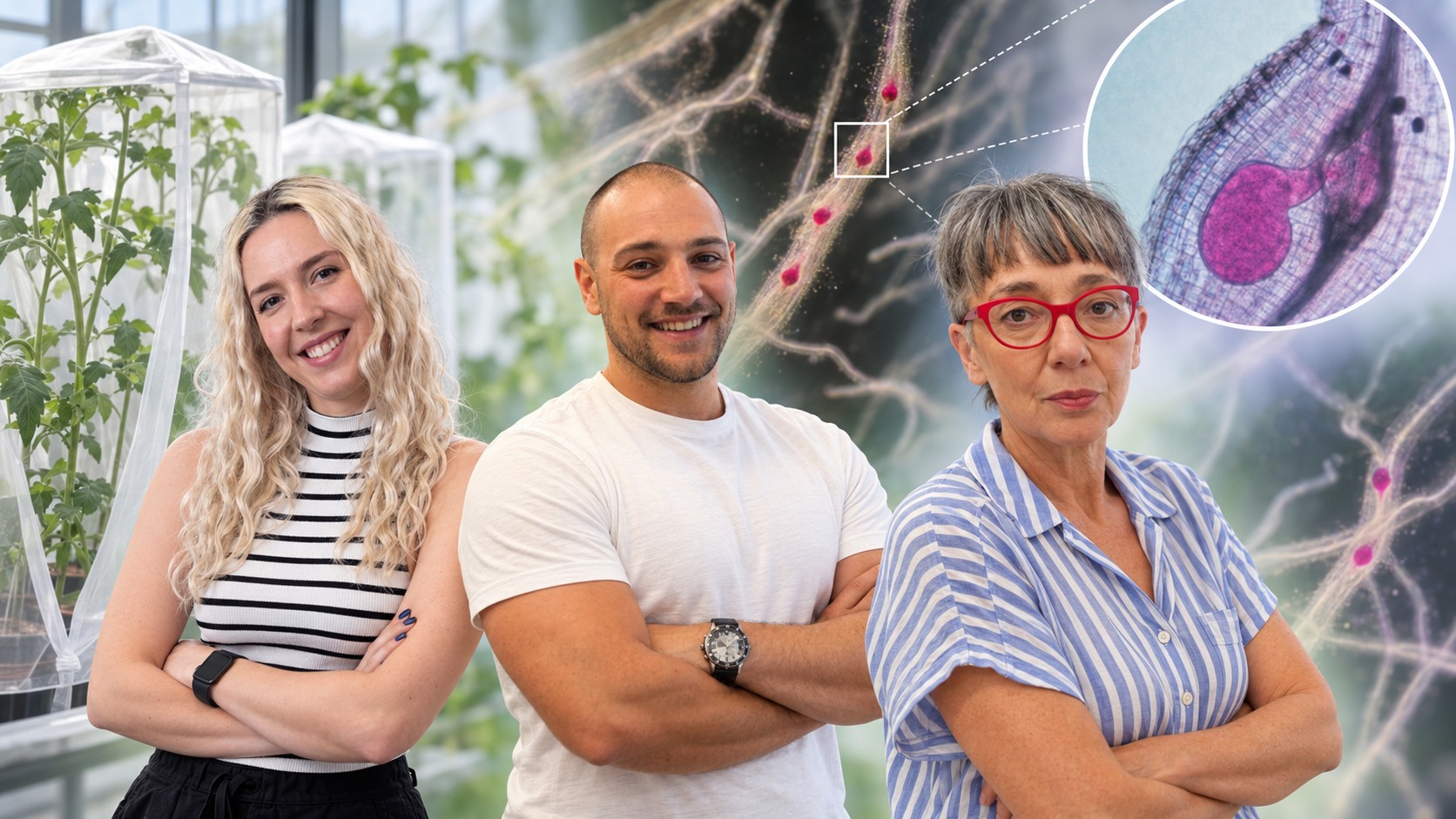
Evelin Despot Slade, Marin Volarić and Nevenka Meštrović.
Cell division is a vital biological process crucial for growth, development, and reproduction. When this process fails, cells may malfunction or die. The central player in this process is the centromere, a key region of the chromosome responsible for cell division. Researchers examining the genomes of six asexual plant parasites have, for the first time, uncovered a correlation between centromere evolution and different modes of reproduction, providing new insight into the evolutionary dynamics of centromeres.
One of the most intriguing questions in cell biology is the centromere paradox, which concerns the conflict between the essential role of the centromere in cell division and its rapid evolution. Previous studies on centromere evolution have mainly focused on sexually reproducing species, in which centromeres play roles in both types of cell division, mitosis and meiosis. An international team of scientists, led by Dr Nevenka Meštrović of the Ruđer Bošković Institute (IRB), compared the centromere organisation of six asexual holocentric nematode species with different reproductive modes, uncovering distinct evolutionary patterns in mitotic versus meiotic species. This research was published in the collection “Centromere Structure and Evolution” in Genome Biology (IF 13.7), one of the most influential journals in the field of biology.
Cell division, through mitosis and meiosis, is fundamental to the growth, development and reproduction of all living organisms. While mitosis ensures the accurate segregation of chromosomes in somatic cells, meiosis creates haploid reproductive cells. Both processes depend on centromeres – specialised chromosomal regions crucial for precise chromosome segregation. Despite their vital role, centromeres are known to evolve rapidly and their DNA and proteins change quickly.
„However, our previous research, published in Molecular Biology and Evolution, challenged this traditional view, demonstrating that centromeres in asexual, mitotic nematodes can be conserved across different species. Building on this discovery, our current study explores how centromeres evolve in both mitotic and meiotic asexual nematodes to understand whether their reproductive strategies influence centromere organization. Interestingly, we found that mitotic species experience notable centromere expansion, likely fuelled by transposable elements—often called 'jumping genes'—while meiotic species display only limited centromere dispersion and the absence of transposons. These insights shed new light on the fundamental processes of centromere evolution“ says Dr Nevenka Meštrović.
Model Organisms
The conservation of both protein and genetic components across distantly related mitotic nematode species in our previous paper, raises the question of whether centromere organization and evolution differs between mitotic and meiotic species. These nematodes are ideal models because some are mitotic, others meiotic, allowing direct comparison of how reproductive modes influence centromere evolution. By focusing on a genus that includes both types, we gained unique insights into the impact of mitosis and meiosis on centromere organization and evolution. Achieving this required highly contiguous genome assemblies and the development of novel computational algorithms to analyse these complex, repetitive regions among these genomes.
Development of Genomic Tools
Assembling centromeres has historically been difficult because of their repetitive nature, but recent long-read sequencing technologies have revolutionised this field. High-quality genomes that include centromeric regions were essential to our analysis. Through collaborations with INRA (France) and UC Davis (USA), we accessed these assemblies before they were publicly available, as we were directly involved in their genome assembly efforts. These genome assemblies were published in Nature Communications and PLOS Pathogens.
„Beyond complete genome assemblies, we faced the challenge of developing algorithms to accurately compare the complex organisation of centromeres across genomes. We analysed six genomes in which centromeres can constitute up to 10% of the genome, requiring the handling of large, highly complex regions. We developed a new pipeline for linear comparison of highly repetitive centromeres and applied Markov chain analysis for the first time to study centromere organisation. This innovative approach enables visualisation of complex centromere structures and has broad applicability on other organisms“, as explained by Dr Evelin Despot Slade and Marin Volarić, first authors of the study.
„Jumping genes“ and centromere evolution
One of the most intriguing questions in cell biology is what drives this rapid centromere evolution and what mechanisms control the formation and spread of centromeric DNA. Previous studies of centromeres have primarily focused on sexual species, in which the same centromere plays a role in both mitosis and meiosis.
Most research has focused on sexual species, but our work shifts attention to asexual nematodes. We compared the genomes of six asexual nematodes and confirmed that both mitotic and meiotic centromeres are epigenetically and genetically determined. In addition, we found that in mitotic species, the initial amplification of centromere units is mediated by non-autonomous transposons, with further expansion driven by autonomous jumping genes, resulting in complex, enlarged and dispersed centromeres. Conversely, meiotic species lack transposon association, limiting the spread of centromeres and indicating that meiosis acts as a suppressor of centromere expansion. This study establishes, for the first time, a clear link between reproductive mode and centromere organisation and evolution,” explains Dr Nevenka Meštrović.
A Significant Step Forward in Understanding Centromere Evolution
This study provides important new insights into centromere evolution, with implications extending beyond basic biology to areas such as plant-parasitic nematode control and cancer genomics. Studying centromere components in non-standard model organisms is essential for understanding the diversity, general principles and evolutionary dynamics of centromere determinants.
For plant-parasitic control, the knowledge about centromere evolution could help to better understand why root-knot nematodes are exceptionally successful and adaptable. Centromere expansion identified in this work may provide greater genomic flexibility, helping them adapt to diverse hosts and environments and potentially supporting new parasite-control strategies.
In cancer research, it is well established that centromere dysfunction can cause chromosome instability, a hallmark of cancer. Studying centromere evolution in unique nematode models may reveal how transposons and centromere expansion contribute to chromosome rearrangements, offering new insights into the origins of genomic instability in cancer.
About the research team
The study was conducted at the Ruđer Bošković Institute (IRB), in the Laboratory for Noncoding DNA (LND), and funded by the Croatian Science Foundation (HRZZ) project “Genomics and Epigenomics of Holocentromeres in Nematodes Meloidogyne,” led by Nevenka Meštrović. The main authors are Evelin Despot Slade and former PhD student Marin Volarić, alongside Nevenka Meštrović. Contributors from IRB are senior scientist Brankica Mravinac and postdoctoral researcher Damira Veseljak, both from LND, and microscopy expert Lucija Horvat. International collaboration was provided by the Etienne Danchin group at INRA, France.
Contact Us
Read more