

One of Europe’s Most Prestigious Research Projects Concludes with Discovery Published in Nature Cell Biology
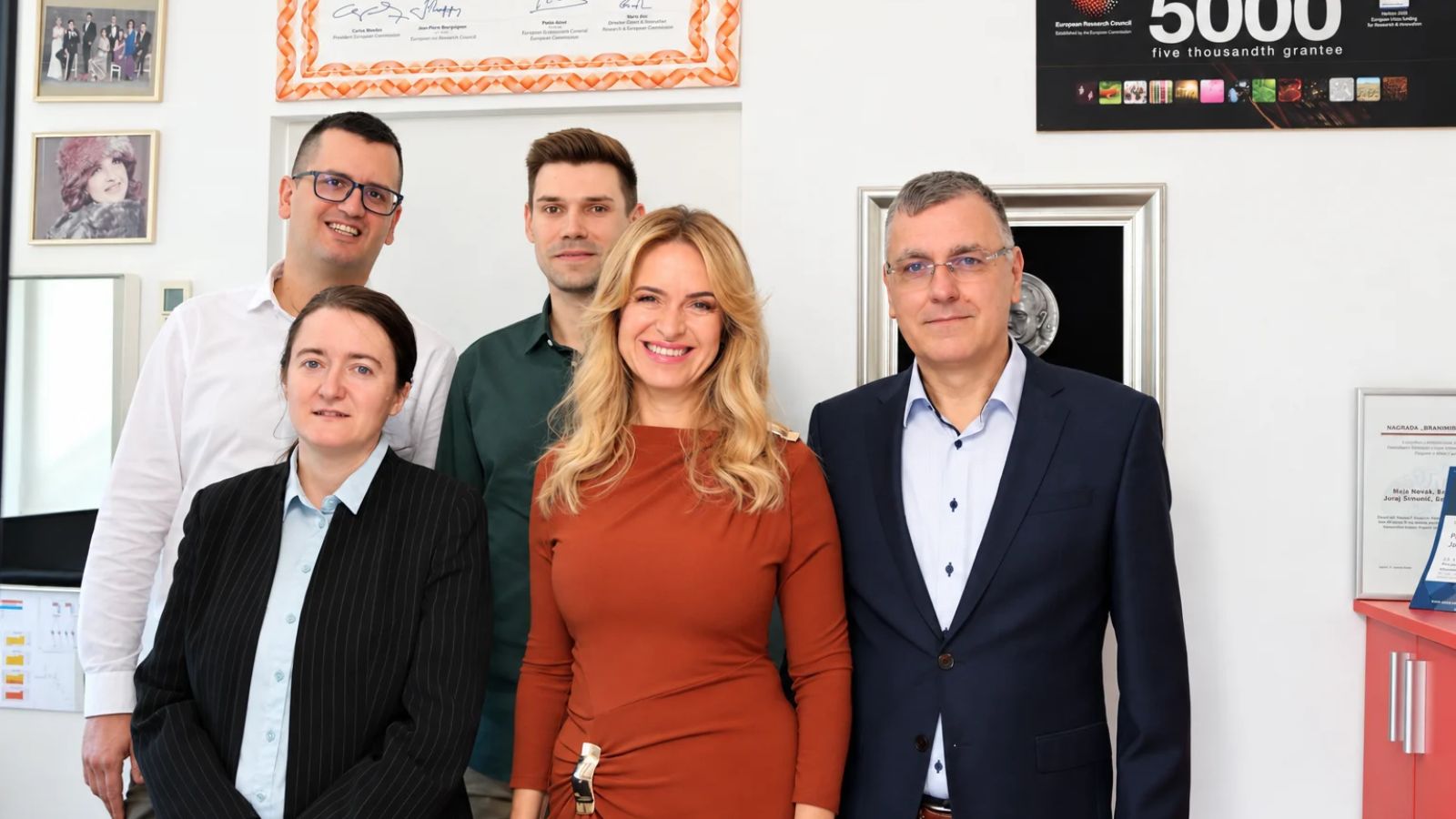
An international research team led by Professor Iva Tolić, a member of the Croatian Academy of Sciences and Arts, from the Ruđer Bošković Institute (RBI), and Professor Nenad Pavin from the Faculty of Science at the University of Zagreb, has uncovered a universal principle explaining how the machinery responsible for cell division adapts to enormous differences in DNA content. The discovery sheds new light on evolutionary changes that may accompany the emergence of new species, as well as on the consequences of errors in chromosome segregation, which are associated with developmental disorders.
The findings are the result of ANEUPLOIDY, a six-year research project worth €10 million. Funding was provided by the European Research Council (ERC) through its Synergy Grant scheme, designed to support ambitious scientific questions that cannot be addressed by a single laboratory or discipline working alone.
ANEUPLOIDY brought together an international team led by Iva Tolić, Nenad Pavin and Professor Geert Kops of the Hubrecht Institute in the Netherlands, alongside researchers from the Massachusetts Institute of Technology (MIT) in the United States.
The project was the first ERC Synergy Grant awarded to researchers and institutions in Croatia. Its completion in 2026 also marks the country's first fully completed project of this kind involving Croatian principal investigators.
More than 15 researchers, technical staff and administrative personnel were employed through the project, which produced an impressive 41 scientific publications. Croatian researchers held significant authorship roles in 33 of these papers, a substantial achievement by international standards.
The latest study, presented to the media and the public today, represents a fitting finale to the project. For the first time, it brought together all the partner teams in a single investigation, combining experiments on living cells, advanced microscopy, biomedical research, physics and mathematical modelling to answer a fundamental question in biology.
What Happens When a Genome Gets Bigger?

akademkinja prof. dr. sc. Iva Tolić i prof. dr. sc. Nenad Pavin
Every dividing cell faces the same essential task: producing two daughter cells, each with the correct set of chromosomes. To achieve this, the cell must distribute its duplicated genetic material accurately between two opposite poles.
This process is carried out by the mitotic spindle, a cellular structure that organises and separates chromosomes during cell division.
Throughout evolution, genome sizes have changed dramatically across different lineages. Today, genome sizes among eukaryotes vary by more than 10,000-fold. Despite these enormous differences, cells from remarkably diverse organisms still rely on the same fundamental mechanism to distribute chromosomes during division.
Until now, there has been no universal explanation for how this machinery accommodates such vast differences in DNA content.
By comparing 25 evolutionarily distant species, ranging from simple eukaryotes to plants and animals, the researchers identified a universal mechanism.
They demonstrated that the greater the amount of genetic material, the wider the region in which chromosomes are arranged before being separated. Crucially, it is not the number of chromosomes that determines this relationship, but their total amount of material.
Chromosomes Are More Than Just Passengers
This is where the story becomes even more intriguing.
The mitotic spindle is not a rigid machine into which the cell must simply squeeze additional chromosomes. Instead, the material it handles actively shapes the geometry of the machinery itself.
As the amount of chromosomal material increases, chromosomes become more densely packed and generate forces between them that help expand the space in which they are organised.
In other words, the load helps shape the machine that carries it.
“This question could not have been answered within the boundaries of a single discipline. Biology showed us how chromosomes behave in living cells, advanced microscopy allowed us to track their dynamics with precision, and physics and mathematics gave us the tools to derive a general principle from individual observations,” explains Professor Iva Tolić.
Physicists Put the Theory to the Test. Cells Provided the Answer.
Identifying a pattern was not enough. The team also needed to explain why it occurred.
Their physical and mathematical model predicted how the mitotic spindle should behave if forces between chromosomes were indeed the key mechanism. The experimental team then tested these predictions in living cells, including by mechanically compressing them.

doc. dr. sc. Maja Novak i prof. dr. sc. Nenad Pavin
“The value of a physical model lies in its ability to make predictions that experiments can either confirm or reject. Our experiments produced precisely the response predicted by the model. This allowed us to move beyond an observed correlation and establish a concrete mechanical explanation,” says Professor Nenad Pavin.
From Evolutionary Patterns to Cells Under the Microscope

Lovro Gudlin i dr. sc. Kruno Vukušić
The researchers found the same principle when they altered DNA content within comparable cells.
“A cell does not accommodate additional DNA simply by scaling up the entire division machinery proportionally. The most pronounced change occurs in the space where chromosomes are organised,” explains Lovro Gudlin of the Tolić Group, who shares first authorship of the paper with Dr Kruno Vukušić from RBI and Dr Maja Novak from the Faculty of Science.
The researchers then deliberately perturbed the system in several ways.
“We varied the amount of chromosomal material, altered microtubule activity, and changed osmotic and mechanical conditions. This allowed us to demonstrate that the length and width of the mitotic spindle are not necessarily governed by the same mechanisms,” explains Dr Kruno Vukušić.
The theoretical work provided another important piece of the puzzle.
“When we varied genome size in our model, we obtained almost exactly the same scaling relationship observed in data from different species. This suggests that a relatively simple physical principle may underlie an extraordinary degree of biological diversity,” says Dr Maja Novak.
Evolution Did Not Need to Invent a New Machine
Major changes in DNA content, including the duplication of entire genomes, have occurred repeatedly throughout evolution.
The new study shows that the mitotic spindle is mechanically adaptable enough to accommodate such changes. This flexibility may have facilitated major evolutionary shifts in genome size, including those associated with the emergence of new species.
Cancer cells may also exploit this adaptability to tolerate substantial changes in DNA content, which can contribute to tumour growth and evolution.
However, this flexibility has its limits.
When the amount of chromosomal material becomes too large, or the space available for cell division is restricted, mechanical stress increases, raising the risk of chromosome segregation errors.
Pushing chromosomal instability beyond the levels cancer cells can tolerate could therefore open up new possibilities for selectively eliminating them, particularly in tumours with enlarged genomes.
Do you like this personality?
Contact Us
Više informacija
ERC