

RBI’s New Accelerator System Goes Live: First Ion Beam Delivered, IAEA Researchers Among First Users
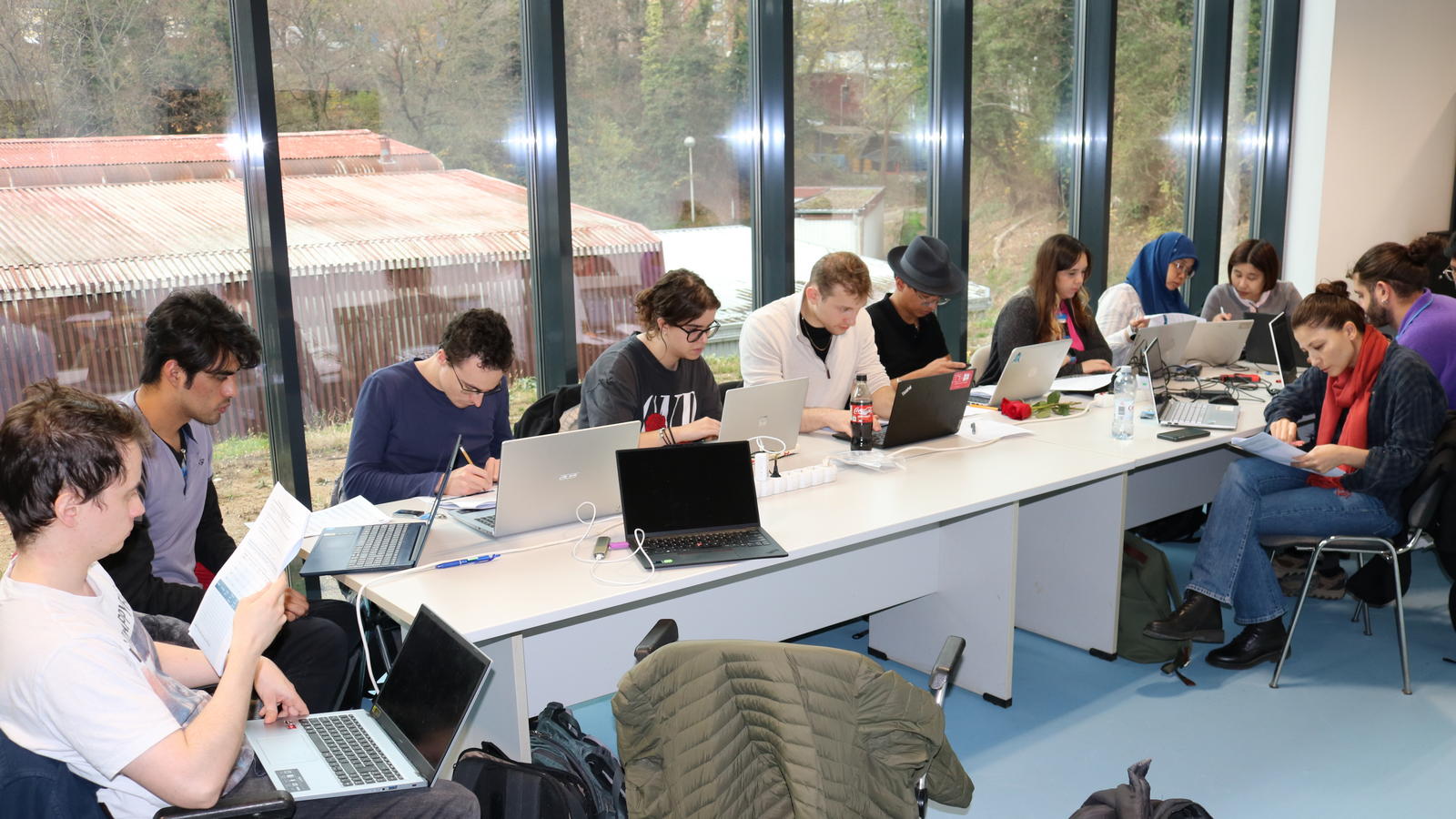
The Ruđer Bošković Institute's Accelerator Centre, Croatia's largest experimental research infrastructure, has achieved two major milestones this month. The smaller 1.0 MV Tandetron accelerator has been brought into operation in the new hall, successfully delivering its first ion beam. The new system has also welcomed its first users: twelve scientists from nine countries taking part in an International Atomic Energy Agency (IAEA) training workshop this week.
From 23 to 27 November, twelve scientists from Brazil, Greece, Indonesia, Mexico, Norway, Portugal, Slovakia, Thailand and Türkiye are receiving hands-on training in ion beam analytical techniques, ranging from accelerator calibration and spectroscopic methods to nuclear microprobe applications.
The practical sessions in the new facility have been made possible by the team at RBI's Laboratory for Ion Beam Interactions, which relocated and brought part of the accelerator system back into operation in just two and a half months.
“Relocating an accelerator in just a few months was a major challenge, but our team has demonstrated that even the most ambitious plans can be achieved. Since the beginning of September, we have relocated and installed the smaller accelerator, along with two experimental beamlines and measurement stations. Meanwhile, we kept the large accelerator in the old experimental hall on standby as a backup, but in the end, we didn't need it,” said Dr Zdravko Siketić, Head of the Laboratory for Ion Beam Interactions at RBI.
“Producing the first ion beam in the new hall is a historic moment for us. The ageing experimental hall and the 6 MV Van de Graaff accelerator, which has been operating since 1987, had begun to pose a serious threat to the Centre's future. The new infrastructure developed through O-ZIP will enable us to carry out world-class research for decades to come.
“The DIGIT OTARI project is helping us manage this transition without losing valuable knowledge and expertise, particularly as some of our technicians are approaching retirement. It will also help us make the Centre more accessible to researchers and industry. We are especially pleased that our first users are participants in an IAEA workshop, continuing a partnership that spans three decades,” Siketić added.

dr. sc. Zdravko Siketić
What Can an Ion Beam Reveal?
Ion beams generated by tandem accelerators are used to analyse the composition and structure of materials, modify their properties and conduct fundamental research in nuclear and atomic physics.
An ion beam is a stream of electrically charged atoms, known as ions, accelerated to speeds of several thousand kilometres per second. When the beam strikes a sample, the material responds by emitting X-rays, gamma rays, scattered particles or products of nuclear reactions.
By analysing these signals, scientists can determine which elements are present in a sample, their concentrations and how they are distributed at different depths, often without causing any damage.
Ion beam techniques have applications across a remarkable range of fields. They can be used to analyse pigments and metals in artworks and archaeological artefacts, identify the elemental composition of airborne pollution particles, develop semiconductor technologies and test the radiation resistance of detectors.
At RBI, ion beams are also used to investigate materials for future fusion power plants.
The nuclear microprobe, which focuses an ion beam to a spot just a few micrometres across, enables researchers to produce detailed maps of elemental distributions within samples. It can also be used to irradiate specific regions of individual cells, helping scientists better understand the effects of radiation in radiotherapy.

Investing in the Centre's Future
The new experimental hall forms part of the Advanced Technologies and Materials Research Platform (TechMat), developed under the Open Scientific Infrastructure Platforms for Innovative Applications in the Economy and Society (O-ZIP) project.
Worth more than €100 million and funded by the European Regional Development Fund, O-ZIP has also financed equipment for the new experimental hall, including a new large accelerator, the 5 MV TDT.
Once its installation is completed in 2027, the Accelerator Centre will be fully operational in its new premises, offering greater reliability and more beam time for users.
“The new facilities and equipment will enable more reliable operations, increased beam time for users and further research in advanced materials, semiconductors and detectors, energy, the environment, biomedicine and cultural heritage.
“The Centre also provides services to industry, including materials analysis and ion implantation. Installation of the new large accelerator is expected to be completed by mid-2027, when the Accelerator Centre will become fully operational in its new location.”
Some of the activities associated with relocating and operating the Centre are co-financed through the OTARI project (Optimisation of the Operation and Use of RBI's Tandem Accelerator Research Infrastructure), worth €338,486.62.
OTARI is funded under the DIGIT programme of Croatia's Ministry of Science, Education and Youth, with support from the World Bank. Its objectives include improving the Centre's operational efficiency, making access to services more transparent for external users and strengthening collaboration with industry.
A donation from the University of Göttingen also played an important role in the relocation, enabling the replacement of several system components.
Three Decades of Collaboration with the IAEA
The workshop builds on a long-standing partnership between RBI and the International Atomic Energy Agency.
Since 1996, the IAEA has operated its own experimental beamline at RBI's accelerator facility. The Agency has also co-financed the acquisition of the Tandetron accelerator and subsequent system upgrades.
With IAEA support, the DiFU dual-beam facility was commissioned in 2019. It is one of only a few facilities worldwide capable of realistically simulating conditions found inside fusion reactors.
The Ruđer Bošković Institute's Accelerator Centre is also part of the Central European Research Infrastructure Consortium (CERIC-ERIC).
Croatia has been a full member of the consortium since 2017 and is represented by RBI, which has participated in its activities since 2014.
Through CERIC-ERIC, researchers from across Europe and around the world can gain access to RBI's ion beam analysis and materials modification techniques through competitive open calls.
To date, more than 50 international research projects have been carried out at the Accelerator Centre through the consortium.
Following a two-year interruption, RBI's ion beam techniques are expected to become available to CERIC-ERIC users again in 2027, marking another important step in bringing the Centre's upgraded research infrastructure into full operation.
About the RBI Accelerator Centre
The Ruđer Bošković Institute's Accelerator Centre is operated by the Laboratory for Ion Beam Interactions within RBI's Division of Experimental Physics. The Centre provides approximately 3,000 hours of beam time to users each year and is the only research infrastructure in Croatia that regularly offers access to international researchers through its participation in European research networks.
The Centre is a member of the Central European Research Infrastructure Consortium (CERIC-ERIC) and an associated centre of IFMIF-DONES, a major research infrastructure project dedicated to developing a neutron source for testing and qualifying materials for future fusion power plants.
IFMIF-DONES is currently under construction in Spain. The RBI Accelerator Centre is expected to contribute by testing selected components of the facility and, once IFMIF-DONES becomes operational, serving as a centre for the preliminary screening and selection of materials before they undergo neutron irradiation.
Contact Us
Digit

European Union
Ministarstvo znanosti, obrazovanja i mladih