
RBI secures €338,000 to strengthen its accelerator centre under the DIGIT project
The Ruđer Bošković Institute (RBI) is among 13 Croatian public scientific institutions awarded non-repayable grants under the Professionalization of Research Centers call. RBI has been granted €338,486.62 for the project Optimization of operation and use of the RBI Tandem Accelerator Research Infrastructure (OTARI), aimed at professionalizing operations and improving the use of the existing accelerator centre. The funding will support the optimization of work organization, an increase in capacity and competencies, stronger links with industry and other research infrastructures, and improved visibility and transparent access to the centre’s services.
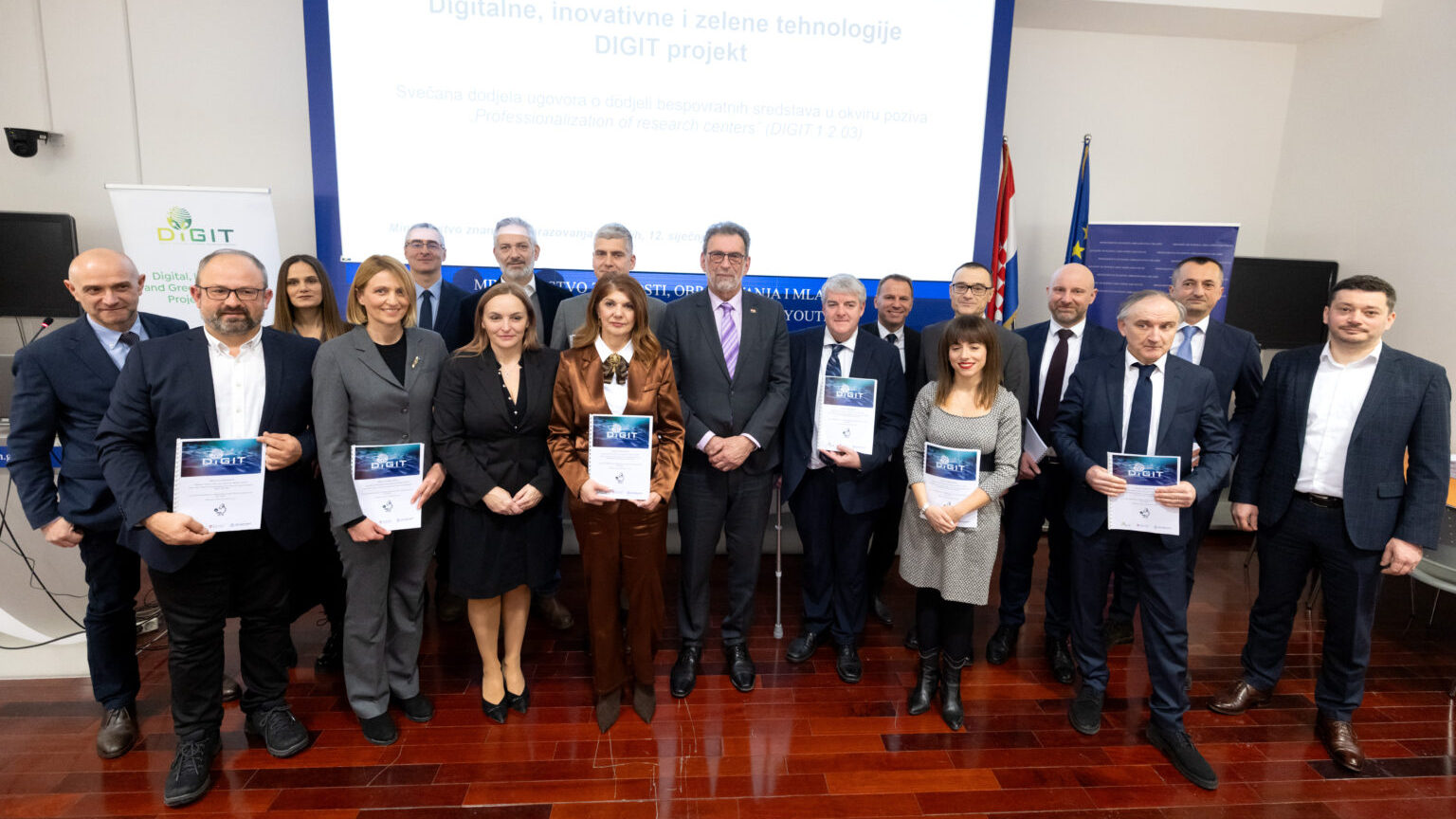
On behalf of RBI, the contract was received by Director Dr David Matthew Smith at a ceremony held at the Ministry of Science, Education and Youth in Zagreb on Monday, 12 January 2026. The call is implemented within the Digital, Innovative and Green Technologies – DIGIT project, with support from the World Bank.
More efficient accelerator operations, more open user access, and stronger industry collaboration
The OTARI project is implemented within the Laboratory for Ion Beam Interactions of the Division of Experimental Physics, and is led by Dr Zdravko Siketić. The team includes Dr Stjepko Fazinić, Dr Milko Jakšić, and Dr Iva Bogdanović Radović. Implementation is planned for the period 1 November 2025 – 31 October 2028.
The funds are directed towards concrete changes designed to increase the utilization of accelerator capacity and improve access to services. These include optimizing the accelerator centre’s organizational and operational models (better planning, more efficient use of working hours and resources), and ensuring a more transparent and user-friendly approach to the centre’s services—such as a new website with a catalogue of techniques and services, an online accelerator usage schedule, a transparent price list, and a clearer application procedure for users.
In addition, capacity and competencies will be increased through the hiring of new technical and professional staff and further training of existing personnel. Efforts will also focus on strengthening collaboration with industry and other research infrastructures through networking workshops, visits to potential industrial partners, and the development of new collaborations.
One of the project’s goals is to optimize the accelerator’s working hours by introducing procedures that more clearly define activity priorities, while additional recruitment and staff training will contribute to stable and safe operation of the accelerator and its supporting equipment.
Semiconductors, energy, materials, environment, and cultural heritage
The OTARI project is particularly focused on strengthening cooperation with the private sector through analytical services, ion implantation, joint product development (e.g., sensors, device management and control systems), and the commercialization of scientific equipment developed at the centre.
The centre’s potential is especially strong in the semiconductor industry, energy, materials and environmental applications, as well as in cultural heritage. Ion-beam analysis and modification services can support characterization and the development of new solutions in industry and research, while in the fields of environment and cultural heritage the project opens opportunities for sample analyses related to identifying sources of pollution and for obtaining data essential for high-quality restoration.
The project will also further strengthen intellectual property protection and commercialization, including preparation for patenting results generated in collaboration with industry or through joint projects. Workshops and seminars are also planned, along with exchanges of experience with other institutions on IP and commercialization.
In the long term, RBI expects a financially self-sustaining accelerator centre that—alongside regular servicing and “cold operation”—can invest in the further development of methods and instrumentation. For researchers and students, the project should provide a more stimulating environment, more international projects, increased recruitment of doctoral candidates, and room for new research topics—thereby indirectly strengthening innovation potential.
About the call and the contract award ceremony
A total of 13 contracts, worth €5 million, were awarded at the Ministry ceremony to public higher-education institutions and public research institutes in the Republic of Croatia. Unlike traditional calls focused on equipment or infrastructure, the Professionalization of Research Centers call is aimed at internal organizational transformation—strengthening managerial, organizational and financial capacities, improving operational efficiency, ensuring long-term sustainability, and fostering openness to collaboration with the private sector. Grants per project range from €60,000 to €350,000.
Among those attending the event were the Minister of Science, Education and Youth Prof. Radovan Fuchs, PhD, the DIGIT project coordinator Dr Hrvoje Meštrić, and World Bank representative Todor Milchevski. In their remarks, they emphasized the importance of professional management of research centres, better use of existing infrastructure, and stronger links between scientific excellence and economic and societal needs.
Contact Us
More info