

Zeolites Can Transport Charge: New Discovery Paves the Way for Smart and Sustainable Materials
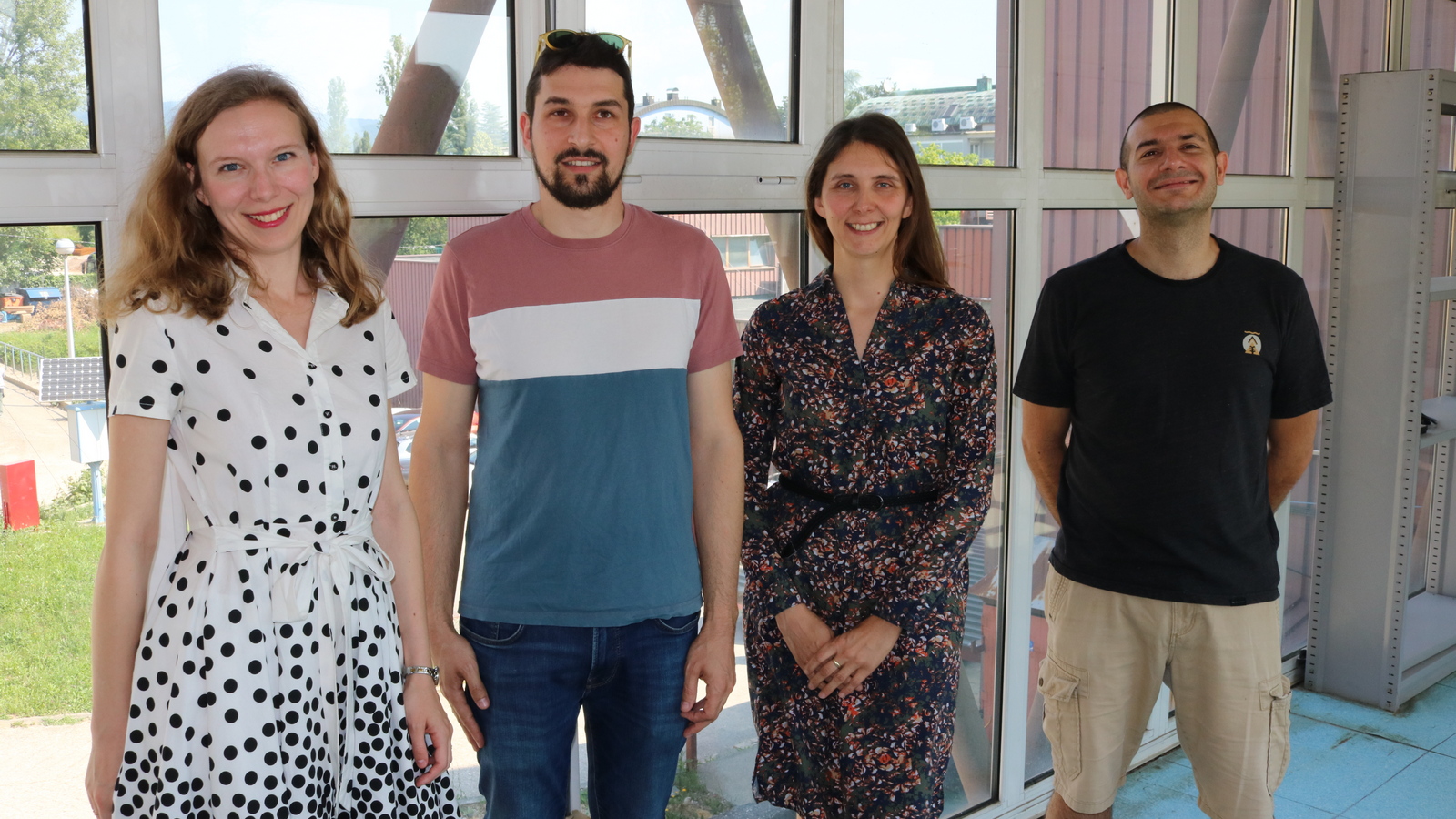
New research by scientists from the Ruđer Bošković Institute shows that charge transport in zeolites can be tuned by controlling particle size and water content. The findings open new opportunities for exploring their use in sustainable functional materials, for example in sensors and other systems where controlled ion transport is essential. The paper was published in the prestigious scientific journal Journal of Materials Chemistry A.
Researchers from the Ruđer Bošković Institute, in collaboration with colleagues from the National Institute of Chemistry in Ljubljana, have shown that zeolites can conduct ionic, or protonic, charge much more efficiently under specific conditions.
Zeolites are porous crystalline materials whose interiors are interlaced with tiny channels and cavities. Water plays a crucial role in this process. When water molecules are present within the zeolite structure and on its surface, protons, small positively charged particles, can move more easily through the material. Under specific conditions, humidity increased the proton conductivity of zeolites by almost four orders of magnitude, or more than 9,000 times.
These research results are important because they show that zeolites, materials that are accessible, stable and environmentally friendly, should not be viewed only as “molecular sponges” for capturing and separating molecules. Their properties can be deliberately modified, for example by adjusting particle size and controlling humidity, making them highly interesting for future sustainable technologies in which the management of ion and proton transport is essential.
“We have shown that zeolites are not only passive porous materials, but materials whose properties can be precisely tuned. What is particularly interesting is that water, which is often perceived as an impurity or an obstacle in a material, plays a key role here in charge transport. This opens up new opportunities for studying zeolites as functional materials for sustainable technologies,” said Dr. Glorija Medak Spahić, first and corresponding author of the paper from the Ruđer Bošković Institute.
Zeolites are materials that scientists often describe as tiny crystalline sponges. Their interiors contain regularly arranged channels and cavities through which molecules and ions can pass. For this reason, they have been used for decades in catalysis, purification, ion exchange, adsorption and gas separation. However, their low conductivity has so far limited broader consideration of zeolites for applications in advanced devices.
In the new paper, the research team studied two types of zeolites from the faujasite group. The scientists compared two samples of the same type of material, one composed of very small, nanometre sized particles, and the other of larger, micrometre sized particles. This comparison allowed them to clearly demonstrate how particle size and the amount of water in the material affect charge transport.
The results showed that under so called dry conditions, when water had been removed from the particle surface but some water remained bound within the internal structure of the zeolite, larger particles transported charge more effectively. This occurs because their internal channels allow protons to move more efficiently. However, at high humidity, the situation changes. Water adsorbed on the surface of the particles and between them becomes increasingly important. This effect is particularly pronounced in nanometre sized particles, which have a larger surface area and more sites where water can bind.
“The reason is that larger crystals contain more connected internal channels through which protons can move more efficiently. However, at high humidity, the picture changes. Water bound to the surface of the particles and between them begins to play an important role. In nanometre sized particles, which have a larger surface area and more places where water can bind, this effect becomes especially pronounced,” explained Dr. Lidija Androš Dubraja, corresponding author of the paper from the Ruđer Bošković Institute.
“This research shows how important it is to distinguish between water located in the internal channels of zeolites and water located on their surface. These two types of water do not affect charge transport in the same way. Understanding this difference is precisely what enables us to better predict and direct the behaviour of the material,” added Dr. Androš Dubraja.
To gain a comprehensive picture of zeolite behaviour, the scientists combined several methods. They analysed the crystal structure, particle size and shape, porosity, thermal properties, the presence of water and the electrical properties of the material. This approach enabled them to connect the structure of the material with its behaviour under different humidity and temperature conditions.
The research showed that removing surface water can reduce conductivity by at least three orders of magnitude, meaning that water on the zeolite surface strongly facilitates charge transport. At the same time, water located deeper within the zeolite structure can have a different role, as it affects the arrangement of ions in the crystal lattice and the speed of their movement.
“The greatest contribution of this work is that we have shown that proton transport in zeolites can be regulated through the microstructure of the material and the amount of water present. This is fundamental knowledge, but it is precisely this kind of research that creates the basis for developing new materials with targeted properties,” added Dr. Glorija Medak Spahić.
The paper was published in the prestigious scientific journal Journal of Materials Chemistry A, which publishes research in the field of materials for energy and sustainability. In addition to Dr. Glorija Medak Spahić and Dr. Lidija Androš Dubraja, the authors of the paper are Dr. Marko Dunatov, Dr. Josip Bronić and Dr. Andreas Puškarić from the Laboratory for the Synthesis of New Materials at the Division of Materials Chemistry of the Ruđer Bošković Institute, and Dr. Jan Marčec from the National Institute of Chemistry in Ljubljana.
Although this is fundamental research, the results show that well known materials can conceal new and technologically important properties. In the future, zeolites could be used in the development of sustainable functional materials, sensors and other systems in which precise control of proton transport is important.
Funding note: The research was financially supported under the Programme Agreements of the Ministry of Science, Education and Youth with the Ruđer Bošković Institute, MZ-2025, project MZ3-25, within the framework of the National Recovery and Resilience Plan from 2021 to 2026, funded by the European Union through the NextGenerationEU programme. Jan Marčec acknowledges the financial support of the Slovenian Research and Innovation Agency through the research programme Nanoporous Materials, P1-0021.
Contact Us
More info