

The Flour Beetle Genome Reveals Unusual Macro Symmetries in Repetitive DNA
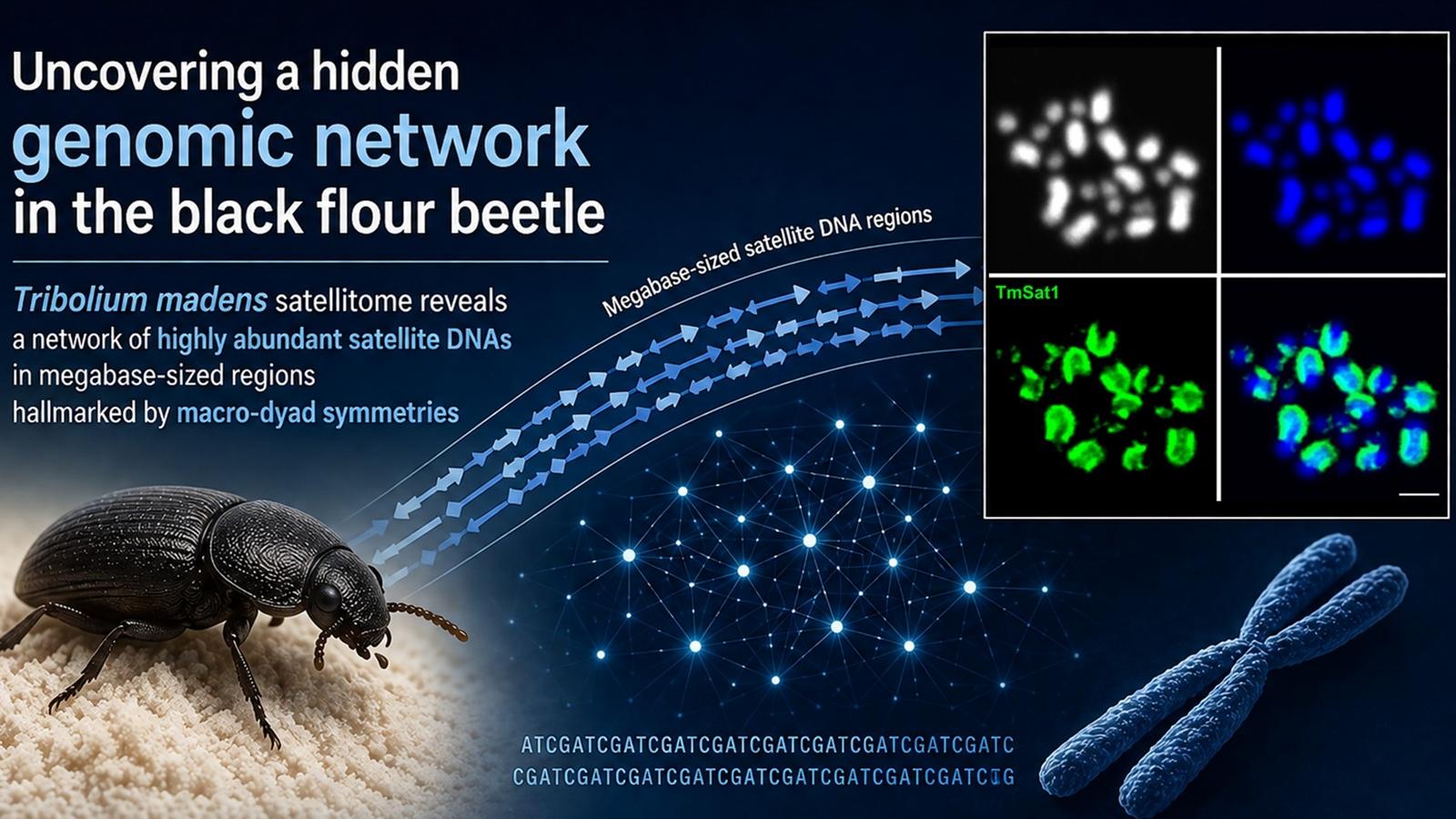
Molecular biologists from the Ruđer Bošković Institute, IRB, working in the Laboratory for Noncoding DNA, have described a previously unrecorded mode of organisation of repetitive DNA in the genome of the black flour beetle, Tribolium madens, in a paper published in Genome Biology. They discovered that large parts of its chromosomes are built from repetitive DNA sequences arranged into long, mirror symmetrical units. Since these patterns are found in centromeres, the parts of chromosomes that are crucial for proper cell division, the results contribute to our understanding of how chromosomes are organised and correctly distributed during division.
The insect Tribolium madens, also known as the black flour beetle, belongs to a group of small beetles often used in research because they are suitable for studying insect genetics, development and evolution. It is particularly important for this study because its genome contains a very large proportion of repetitive DNA regions, making it a good model for investigating parts of the genome that have long remained poorly understood.
From “Junk DNA” to a Key Piece of the Genomic Puzzle
Understanding how chromosomes are organised and correctly distributed during division is important because this process ensures that each new cell receives the correct set of genetic information. Errors in chromosome distribution can have serious consequences for cell function and are associated with developmental disorders, infertility and cancer.
For many years, tandemly repeated DNA sequences, known as satellite DNA, were considered an unimportant and redundant part of the genome, even referred to as “junk DNA”. The function of satellite DNA is still not fully understood, but it is known that these sequences are often located in centromeres, chromosomal regions essential for the proper distribution of genetic material during cell division.
One path towards discovering the function of satellite DNA lies in uncovering how it is organised in the genome. However, precisely because it consists of a large number of repeats, these DNA regions are particularly difficult to read and assemble into a complete picture of the genome. As a result, although satellite DNA is often highly abundant in genomes, it is frequently incompletely represented or entirely omitted from genome assemblies. IRB scientists faced this challenge when they set out to investigate the complete collection of satellite DNA in the genome of Tribolium madens.
The Path to Discovering Macro Symmetries
“When we began the project, a genome assembly for this insect was already available in a scientific repository. However, the genome assembly prepared by American scientists was almost entirely lacking satellite sequences and was therefore unusable for our purposes. As a first step, we therefore had to resequence the genome and assemble it again without omitting the repetitive regions,” explained Dr. Brankica Mravinac, research leader and corresponding author of the paper.
By combining short and long read DNA sequencing technologies, IRB scientists succeeded in reconstructing large repetitive regions of the genome and creating a high quality basis for further analyses. The analyses showed that satellite DNA accounts for as much as 41 percent of the genome, and in addition to two previously known satellite DNAs, the researchers discovered another 122.
“Tribolium madens proved to be an excellent model for studying satellite DNA, and what especially surprised and delighted us was the unconventional way in which these sequences are organised in the genome,” said Dr. Mravinac. For the two dominant satellite sequences, which together make up almost 38 percent of the genome, the scientists discovered that their repeats are arranged in mirror symmetrical patterns, which the authors named macro symmetries.
The Importance of Macro Symmetries in the DNA Molecule
When parts of a linear DNA sequence are arranged like a mirror image, the DNA can adopt more complex three dimensional forms, for example structures resembling a cross or a hairpin. Such structures can interact with specific proteins and influence how chromosomes are organised and how they function.
“It is known that satellite sequences can contain shorter mirror symmetries within their repeat units, usually composed of just a few nucleotides. In rare cases, more complex repeat units can contain symmetries of several hundred nucleotides. However, the macro symmetries we identified in Tribolium madens extend up to 75,000 nucleotides. It is also important to point out that the alternating arrangement of macro symmetrical stretches of the two dominant satellites extends across millions of nucleotides in centromeric regions. Such a complex type of satellite sequence organisation has not been reported in the literature so far,” explained Dr. Damira Veseljak, first author of the paper.
These large, mirror arranged arrays of repetitive DNA could play an important role in determining where the centromere is located on a chromosome and how it is organised. It is particularly interesting that the scientists found a similar organisational pattern in related species of the genus Tribolium, even though their DNA in these chromosomal regions differs greatly. This finding could help explain how centromeres retain the same essential role in cell division, even though their DNA changes rapidly during evolution. In other words, the organisation of repetitive DNA units may be more important for proper centromere function than the nucleotide sequence within the repeat unit itself.
Who Stands Behind the Research?
The research, carried out entirely at the Division of Molecular Biology, was published in the paper titled “Tribolium madens satellitome reveals a network of highly abundant satellite DNAs in megabase sized regions hallmarked by macro dyad symmetries”. The authors are Dr. Damira Veseljak, Dr. Evelin Despot-Slade, Dr. Marin Volarić, Lucija Horvat, Dr. Nevenka Meštrović and Dr. Brankica Mravinac.
The research was funded by the Croatian Science Foundation, HRZZ, through project IP-2019-04-5522. Open access publication of the paper was supported by IRB programme funds ZI1-26, intended to encourage publication in prestigious journals, under the NextGenerationEU programme.
Contact Us
Više informacija

HRZZ