

Donation from the Terry Fox Run presented to the Ruđer Bošković Institute
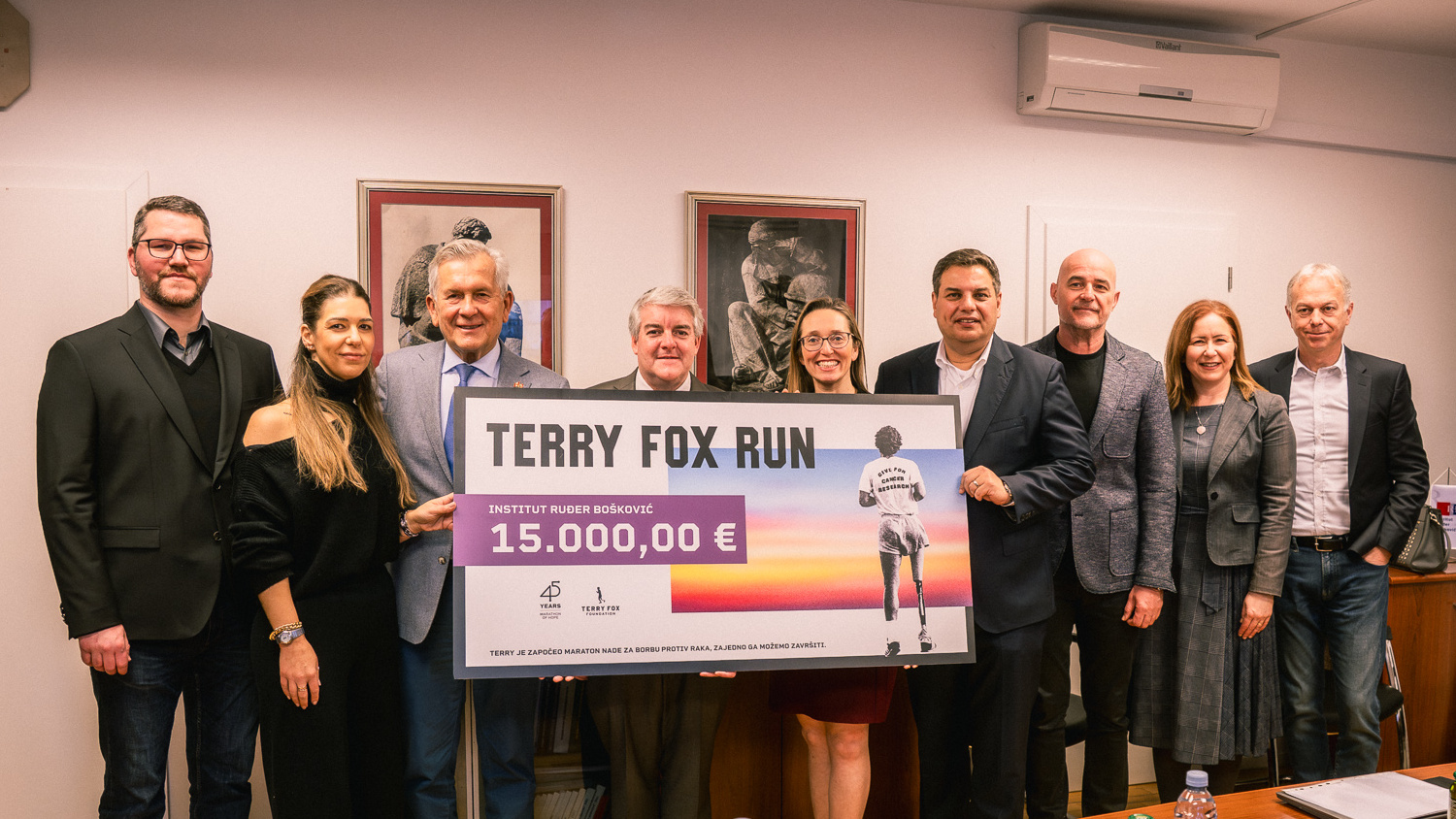
Photo: Marko Lopac
As part of the Terry Fox Run charity race held last autumn at Jarun in Zagreb, €15,000 was raised and presented to the Ruđer Bošković Institute to support research into new prognostic biomarkers and therapeutic targets for lobular breast cancer.
The world’s best-known charity run, the Terry Fox Run, took place in Croatia last autumn for the 26th year in a row, bringing together almost five thousand participants. Thanks to such a strong turnout of generous people who contributed by purchasing commemorative T-shirts and making donations, significant funds were raised and were presented to the Ruđer Bošković Institute last week.
The ceremonial presentation of the donation was attended by the Ambassador of Canada to Croatia, Jessica Blitt, the President of the Croatian League Against Cancer, Prof Damir Eljuga, PhD, the Director General of the Ruđer Bošković Institute, David Matthew Smith, PhD, Dr Petar Ozretić, Head of the Laboratory for Hereditary Cancer at the Ruđer Bošković Institute and lead of the project researching new prognostic biomarkers and therapeutic targets for lobular breast cancer, Joe Bašić, founder and CEO of MPG, the company behind the organisation of the Croatian edition of the Terry Fox Run, Illeana Cesarec, MPG Management Board member and spokesperson for the charity initiative, Ivica Max Krizmanić, General Manager of the Esplanade Zagreb Hotel, Ivan Gabrić, CEO of IN2, the largest donor to the charity initiative, as well as other members of the organising committee.
“Terry Fox was a true Canadian hero, and his courage and determination united Canadians and inspired the world. What began as one young man’s vision to run the Marathon of Hope has grown into a legacy that brings people around the world together for a shared purpose, the fight against cancer. We are proud that the Terry Fox Run in Zagreb has become a beloved Croatian-Canadian tradition, and the funds raised through this year’s initiative will support vital cancer research at the Ruđer Bošković Institute,” said Ambassador Jessica Blitt.
The President of the Croatian League Against Cancer, Prof Damir Eljuga, PhD, highlighted that all stakeholders in this charitable initiative unanimously agreed that the donation should be presented in the days leading up to the World Day of the Sick, observed on 11 February.
“I am extremely pleased that we presented the Terry Fox Run donation this year, and specifically to the Ruđer Bošković Institute, for cancer research and the discovery of new medicines. With undisguised pride, I would like to point out that this year the Croatian League Against Cancer is marking the 60th anniversary of its founding,” added Prof Damir Eljuga, PhD.
“I would like to thank the organisers of the run, above all the Embassy of Canada in the Republic of Croatia, the Croatian League Against Cancer, and all other partners, and especially the citizens who took part in the charitable initiative. The donated funds will be used to continue cancer research at the Ruđer Bošković Institute, in the Laboratory for Hereditary Cancer of the Division of Molecular Medicine, and in the Division of Molecular Biology,” said David M. Smith, PhD, Director General of the Ruđer Bošković Institute.
Invasive lobular breast cancer is harder to detect
Dr Petar Ozretić, senior research associate, Head of the Laboratory for Hereditary Cancer, and head of the project “The Hedgehog-GLI signalling pathway as a source of new tumour biomarkers and therapeutic targets for lobular breast cancer,” spoke about the immense importance of investing in research and thanked the donors on behalf of the entire team.
“Breast cancer is the most common type of cancer in women, affecting around 2.3 million women worldwide each year, and around 3,000 women in Croatia. The second most common histological subtype of breast cancer is so-called invasive lobular breast cancer, which accounts for about 15% of all cases and is characterised by many negative features, it is harder to detect on mammography, it more often occurs in both breasts, relapse and resistance to antihormonal therapy are more frequent. Within this project, using clinical samples and cellular models, we plan to investigate in detail the role of the Hedgehog-GLI signalling pathway in this subtype of breast cancer, with the aim of identifying new prognostic biomarkers for better stratification of patients with an unfavourable prognosis, as well as new combinations of therapies for the successful treatment of advanced, antihormone-resistant cases,” said Dr Petar Ozretić.
Terry Fox Run returns to Jarun in 2026
On 20 September, residents of Zagreb will have the opportunity at Jarun to join this commendable charity initiative for the 27th year in a row, an initiative that for decades has not only raised significant funds for the advancement of science, but has also fostered solidarity, built togetherness and trust, and, most importantly, created hope.
Terry Fox (1958, 1981) was a Canadian athlete, humanitarian, and activist whose epic Marathon of Hope in 1980 inspired millions of people around the world to join the fight against cancer through participation and donations. In Croatia, this commendable initiative has been held for 26 consecutive years. It is organised by the MPG agency, the Croatian League Against Cancer, and the Embassy of Canada, co-organised with the City of Zagreb, in cooperation with the Esplanade Zagreb Hotel and the agencies envy and Zebra komunikacije, and held under the patronage of the Ministry of Health, the Ministry of Science, Education and Youth, the Ministry of Tourism and Sport, and the Mayor of the City of Zagreb.
Terry’s goal was not only to run the Marathon of Hope, but to raise awareness and motivate people to help find a cure for cancer. Today, decades after his first step, the message resonates even more strongly and encourages us to achieve that goal together. Steps of hope are often the hardest, but they are the ones that lead to the finish line.