

In Madrid, the energy future is being shaped: Croatia, led by the Ruđer Bošković Institute, joins the global leaders in fusion
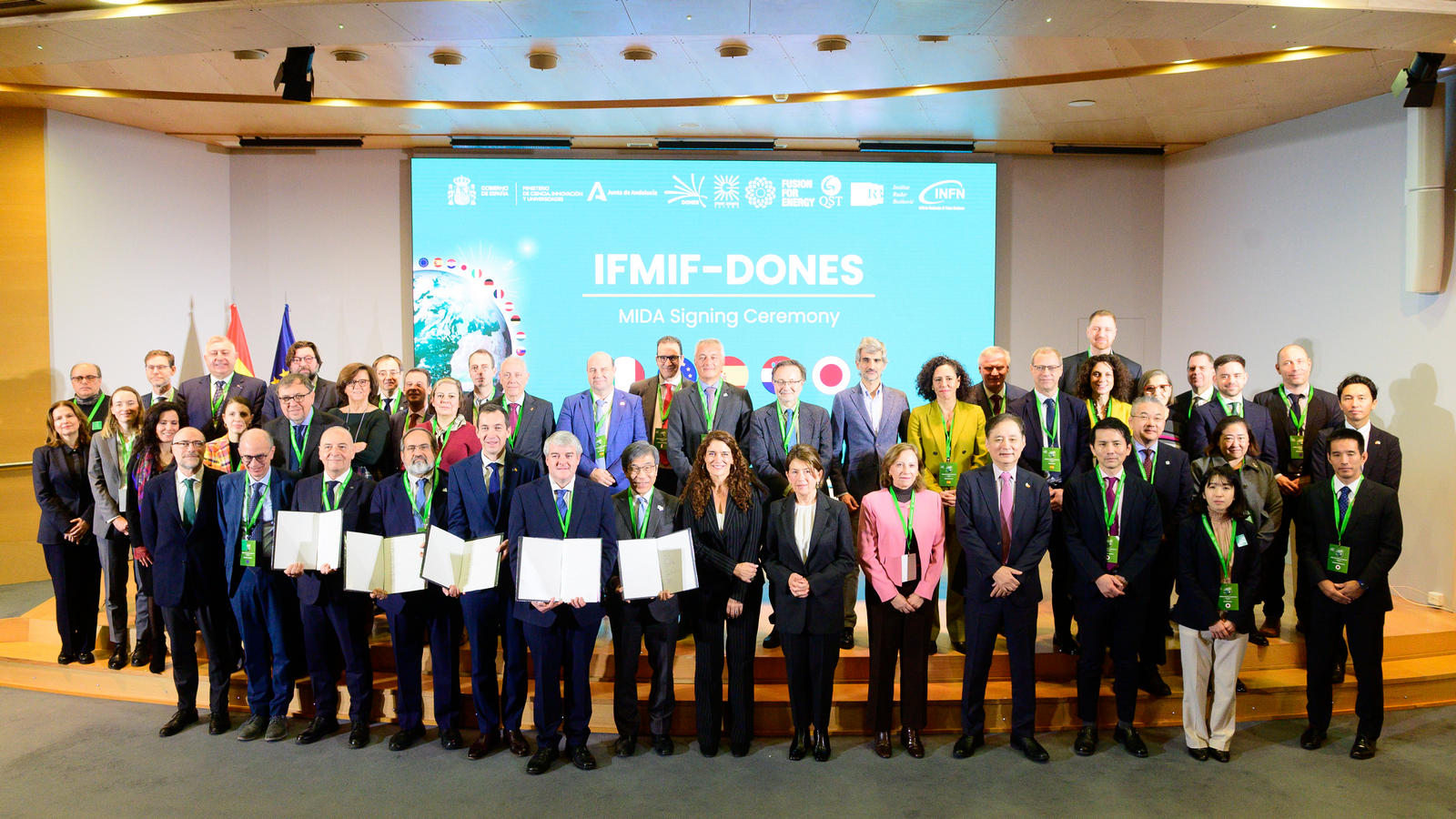
Today in Madrid, the Multilateral International DONES Agreement (MIDA) was signed, establishing a solid institutional and legal framework for governing the DONES project, an international research mega facility essential for the development of fusion energy. By signing this historic agreement, five scientific partners have created an international governance structure for a key fusion energy infrastructure, positioning the EU as a global frontrunner in the race for sustainable energy. The Republic of Croatia and the Ruđer Bošković Institute (IRB) are part of this elite group.
DONES (International Fusion Materials Irradiation Facility, Demo Oriented NEutron Source) is an international scientific research project aimed at building an advanced neutron source to test new materials needed for future fusion power plants, thereby accelerating the development of safe and sustainable fusion energy.
Exactly three years after the DONES project was launched with the signing of a Memorandum of Understanding between the Minister of Science and Education of the Republic of Croatia, Radovan Fuchs, and the Minister of Science and Innovation of the Kingdom of Spain, Diana Morant, signed in the presence of Spain’s King Felipe VI and the President of the Republic of Croatia, Zoran Milanović, the project today entered a new, crucial phase.
The Agreement initiates a forty year period of cooperation in governance, resource allocation, and scientific development of the DONES facility in Escúzar, near Granada. The first phase covers ten years of construction, with completion planned by 2035, while the second phase encompasses thirty years of scientific operation, lasting until the mid 2060s.
Today, the Agreement was signed by institutions that, on behalf of the five parties, Spain, Croatia, Italy, Japan, and the European Commission (EURATOM), assume responsibility for the development, construction, and management of DONES. These are: DONES España, the Ruđer Bošković Institute on behalf of the Croatian consortium DONES.HR, the Italian National Institute for Nuclear Physics (INFN), Japan’s National Institutes for Quantum Science and Technology (QST), and Fusion for Energy, the European Union agency for fusion energy. Germany is also expected to join this international agreement soon, further expanding the circle of key partners.
Croatia in the inner circle of global partners
The MIDA signing ceremony was held at the Spanish Ministry of Science, Innovation and Higher Education in Madrid, with directors and representatives of all partner institutions in attendance. Croatia was represented by Dr David M. Smith, Director General of the Ruđer Bošković Institute, who signed the Agreement on behalf of the national consortium DONES.HR.
“Through this, IRB officially enters the narrow circle of world institutions directly shaping the development of materials needed for a new generation of fusion reactors,” said Dr David M. Smith, emphasizing that participation in this project strengthens the positioning of Croatian science within European research infrastructures. “This is the result of our researchers’ expertise and a clear confirmation of the trust that international partners place in Croatia’s scientific capacity.”
“In the context of the global race for fusion, where China is also developing its own similar device, DONES represents a unique international infrastructure. Anyone wishing to participate in the development of fusion energy will have to either become a partner, negotiate access to experimental capacities, or attempt to develop a similar device without access to the knowledge and experience currently held by DONES partners,” explains Dr Tonči Tadić, Head of Croatia’s fusion activities and Coordinator of the DONES.HR project team at IRB.
The Croatian delegation at the signing included H.E. Nives Malenica, Ambassador of the Republic of Croatia to the Kingdom of Spain, Staša Skenžić, Head of the Independent Sector for Coordination of European Affairs and International Cooperation at the Ministry of Science and Education (MZOM), Dr David M. Smith, Director General of IRB, Dr Tonči Tadić (IRB), Dr Kristina Tomić Luketić (IRB), Daniela Lučev, Advisor at the Embassy of the Republic of Croatia, and Dr Stjepko Fazinić (IRB).
The DONES facility is the missing link without which there can be no fusion power plant
Fusion energy, as a potentially inexhaustible and safe source of clean energy, has been in the focus of the global scientific community for decades. However, for a fusion power plant to operate, two key technical challenges must be solved: ITER, which is expected to achieve a stable fusion reaction, i.e., a burning plasma, by the middle of the next decade, and DONES, which will enable testing of materials capable of withstanding the extreme temperatures and fast neutron radiation present in a fusion reactor.
“Without DONES, it is impossible to safely construct a fusion power plant. Beyond materials testing, DONES will play a key role in developing tritium breeding technology, an isotope that does not exist in nature in sufficient quantities, yet is essential for future fusion power plants. Every reactor will need to produce its own fuel, and DONES is the only global platform that enables experimental testing of these processes,” says Dr Tonči Tadić.
Although primarily focused on fusion energy, DONES will also enable a wide range of additional research, such as testing the resilience of electronic systems to neutron radiation, applications in biomedicine, solid state physics, astrophysics, and advanced materials, and industrial neutron tomography, for example, diagnostics of damage in aircraft engines and vehicles.
DONES gains new leadership and enters the next phase of development
Representatives of 17 countries gathered for the MIDA signing ceremony. Alongside the Director General of IRB, the Agreement was signed by the heads of partner institutions, including Dr Ángel Ibarra, Director of IFMIF DONES España, Marc Lachaise, Director of Fusion for Energy, Dr Shigeo KOYASU, President of Japan’s National Institutes for Quantum Science and Technology, and Dr Diego Bettoni, Vice President of the Italian National Institute for Nuclear Physics.
The MIDA signing ceremony was followed by a meeting of the DONES Steering Committee, where strategic programs will be discussed, including changes to the governance structure and work plans for the coming period. Based on the agreement at the meeting, Staša Skenžić, Head of the Independent Sector for Coordination of European Affairs and International Cooperation (MZOM), will assume the role of Chair of the DONES Steering Committee for the next two years.
The DONES.HR consortium is Croatia’s national scientific platform within the international DONES project, bringing together key research and academic institutions to ensure Croatia’s expert contribution to the development of fusion energy. In addition to the Ruđer Bošković Institute, which leads the consortium, DONES.HR includes the Institute of Physics (IF), the Faculty of Science, University of Zagreb (PMF), the Faculty of Mechanical Engineering and Naval Architecture, University of Zagreb (FSB), the Faculty of Electrical Engineering, Mechanical Engineering and Naval Architecture, University of Split (FESB), the Faculty of Metallurgy, University of Zagreb, and the University of Slavonski Brod.