
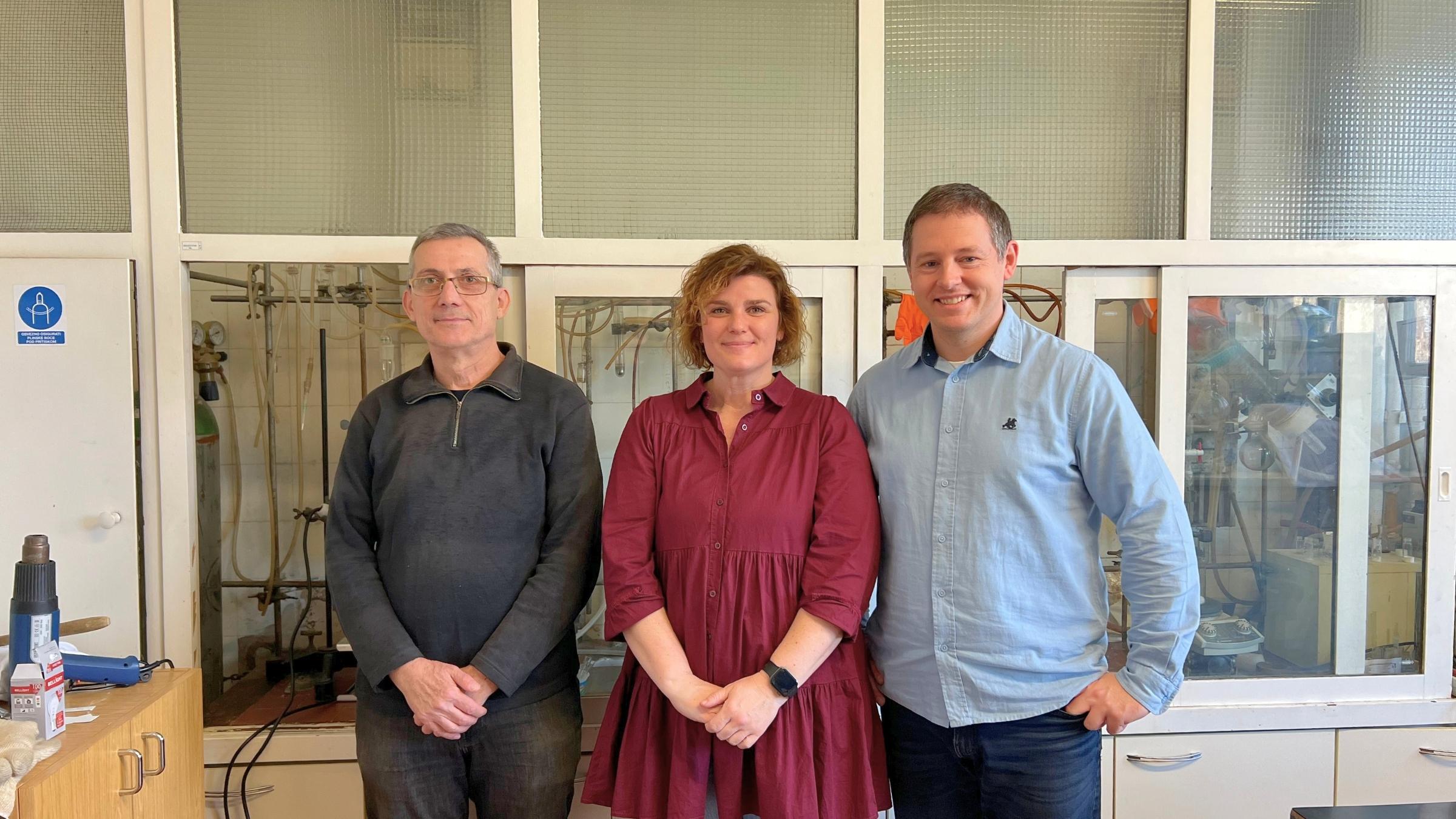
That is exactly what mechanochemical ball mills do, and in a new publication, Dr Vjekoslav Štrukil, Dr Anamarija Briš and Dr Davor Margetić of the Division of Organic Chemistry and Biochemistry at the Ruđer Bošković Institute provide a comprehensive overview of the field, whose development was once set in motion by their own research. In a world that produces more than 400 million tonnes of plastic each year, while recycling only about nine percent, the question of how to break down plastic waste efficiently is becoming increasingly urgent.
Their paper, entitled Mechanochemical ball milling as an emerging tool in chemical recycling and upcycling of waste polymers, was published in Green Chemistry, one of the world’s leading journals in sustainable chemistry published by the Royal Society of Chemistry, and was selected for the cover of that issue. It was also featured in two themed collections, 2025 Green Chemistry Reviews and Make Polymers Sustainable, Why and How? in Polymer Chemistry. In the paper, the authors systematically examine how ball milling has, in a short time, developed into one of the most effective methods for the chemical recycling of plastic waste, from the earliest laboratory successes to the present day.
Balls Instead of Solvents and High Temperatures
At first glance, the principle of mechanochemical ball milling is simple. Steel balls, shredded polymer and an appropriate reagent are placed in a metal or ceramic vessel. The vessel is then shaken or rotated at high speed, and the energy of the collisions breaks the chemical bonds in the polymer chains. The reaction takes place in the solid state, at room temperature and atmospheric pressure, without the need for organic solvents.
The result is the breakdown of the polymer into monomers, the basic building units from which the plastic was originally made. These monomers can then be reused to produce new plastic of the same quality. Unlike conventional mechanical recycling, which merely shreds and remelts plastic into a product whose quality declines with every processing cycle, this approach chemically returns the material to its starting point.
“Plastic waste pollution is one of the key global challenges requiring an urgent response and innovative solutions in line with the principles of green sustainability and circular waste management,” says Dr Štrukil. “Mechanochemistry, with its potential to transform existing chemical processes into their ‘green’ variants, enables the efficient degradation of waste polymers with high monomer yields through the use of ball milling.”
What Does the New Review Paper Bring?
In the paper, the authors provide a systematic overview of all achievements to date in the application of ball milling to the chemical recycling of waste polymers. It covers polymers for which the method already delivers excellent results, such as PET, polycarbonate and polylactide, whose degradation by milling proceeds with high efficiency because they contain chemical bonds that are relatively easy to cleave by mechanical force. However, the paper also addresses addition polymers such as polystyrene, polyethylene and polypropylene, for which degradation is far more demanding because their backbone consists exclusively of carbon to carbon bonds, which are much more resistant to breaking.
Special emphasis is placed on the contribution of the RBI group. In 2021, Dr Štrukil published in ChemSusChem the first study of complete mechanochemical depolymerisation of waste poly(ethylene terephthalate), PET, at room temperature and atmospheric pressure, with yields of up to 99 percent. That paper, rated a Very Important Paper, VIP, sparked a global trend in research and application of mechanochemistry for plastic degradation.
“Our results encouraged further research in groups around the world and significantly influenced the development of the entire field of mechanochemical degradation of plastic waste,” explains Dr Štrukil. “In this review paper, we provide a comprehensive picture of what has been achieved in the meantime, including the shift toward the degradation of polyolefins such as polyethylene and polypropylene, which make up the largest share of plastic waste worldwide.”
Toward Closing the Loop
The current global system for plastic recycling is nowhere near sufficient. Most mechanical recycling facilities cannot produce material of the same quality as the original, while conventional chemical recycling requires high temperatures, high pressures and large quantities of solvents. Mechanochemical ball milling offers an alternative that operates under mild conditions and enables complete breakdown to monomers, thereby closing the loop in terms of circular materials management.
Challenges such as scaling up the process to industrial level and ensuring economic viability remain unresolved. However, the rapid progress in a field originally set in motion by research at the Ruđer Bošković Institute provides grounds for optimism that mechanochemical ball milling could become an important tool in the future of plastic recycling.