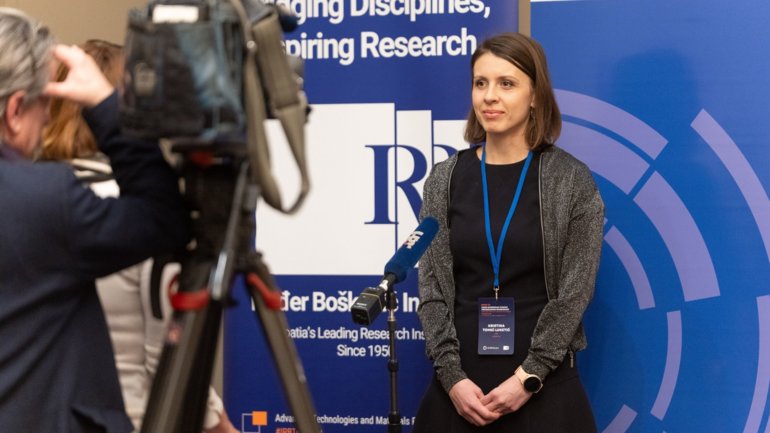

These are precisely the questions that Ivana Perkovac, a journalist with HRT, explored in a feature for the programme Globalna Hrvatska on Croatian Radio Television, in which she spoke with IRB scientists Dr Antica Čulina and Dr Salvatore Marco Giampaolo, as well as the Institute’s Director, Dr David Matthew Smith
Through their answers, a broader story emerges: one about scientific mobility, return, working conditions, and the reasons why the Ruđer Bošković Institute is becoming an increasingly visible meeting point for Croatian researchers returning home and international scientists arriving from abroad.
Science Without Borders
Science knows no borders, neither those set by curiosity nor geographical ones. It has no single homeland, because by its very nature it is global, open, and mobile. A scientist begins their journey at one university, continues it through doctoral study abroad, and expands it further through postdoctoral training and international collaboration. In that world, movement is natural, almost expected. Scientists leave to learn, to work with the best, to build experience, and to find an environment in which their ideas can grow.
And yet, among all those international trajectories, some lead back to Zagreb. After Oxford, the Netherlands, Germany, or another scientific centre, returning to the Ruđer Bošković Institute becomes, for many, both a continuation of a scientific career and the beginning of an important story about knowledge returning home and experience enriching Croatian science.
Ruđer has always been a meeting place for different disciplines, scientific approaches, and generations of researchers. Today, it is increasingly becoming a meeting place for different life paths as well. Croatian scientists come to the Institute after years of work at prestigious European and global institutions. Foreign researchers come too, drawn by Ruđer’s openness, its multidisciplinary character, and the opportunity to continue doing serious, internationally relevant science in Zagreb.
Since 2019, a total of 31 scientists has been employed at the Ruđer Bošković Institute through the competent ministry’s “Returning Scientist” measure, 17 of them Croatian citizens. That figure points to a trend, but it is only the personal stories behind it that reveal its true meaning.
One of those stories is that of Dr Antica Čulina, a scientist who returned to Croatia after completing her doctorate at the University of Oxford and working at the Netherlands Institute of Ecology.

Antica Čulina
Speaking about her research path and the topics she is now working on at IRB, Dr Čulina explains that from the very beginning she was interested in how different relationships in nature shape animal communities. “I find the question of social networks and how they affect reproduction in birds very interesting,” says Dr Čulina, adding that it was precisely through such questions that she gradually developed a broader interest in open science and meta-science.
Today, she notes, she is also concerned with the system of science itself, its weaknesses, and the possibilities for improving it. “Unfortunately, like all systems created by humans, the wider scientific system is vulnerable to problems and corruption. What I work on is how to improve such a system,” she says.
Returns like these leave a mark that extends far beyond a single laboratory or a single project. They bring with them experience of working within different scientific cultures, an understanding of high standards, a habit of international collaboration, and the conviction that ambitious research programmes can be built here as well. They also bring a valuable breadth of perspective, the kind that comes from comparing different systems and seeing clearly what should be preserved and what should be changed. The HRT feature aired on HRT 2, Globalna Hrvatska, on March 19, 2026.
A Return That Raises RBI Visibility
At IRB, such returns have already had a concrete impact. The return of scientists such as Dr Jelena Bujan, Dr Ana Sunčana Smith, and Dr Iva Tolić, who brought prestigious European Research Council projects to IRB, with Dr Tolić having been awarded no fewer than two ERC projects, has shown just how much experience gained at leading international institutions can contribute to the Institute’s development.
Their successes have helped strengthen IRB’s international visibility, open new research topics, and create room for the development of new teams.
An Institute That Is Not Waiting Only for Returnees
But the story of Ruđer is not only the story of those who are coming back. Increasingly, it is also the story of those who are arriving. Today, the Institute employs more than 1,000 people, including more than 800 scientists and researchers working across a broad range of fields, from physics and chemistry to molecular biology and marine and environmental research. It is precisely that breadth, together with strong international connections, that makes IRB attractive even to scientists who have no personal biographical link to Croatia.
A good example comes from the Division of Theoretical Physics, where international researchers such as Dr Fabio Franchini and Dr Salvatore Marco Giampaolo work in the Condensed Matter Physics and Statistical Physics Group.
In 2024, their team developed a new approach to quantum batteries, advanced energy-storage systems that could one day be important for quantum computers, simulators, and sensors. In that work, produced in collaboration with scientists from Croatia, France, and Italy, they showed how energy loss can be reduced through improved quantum-system design. Results like this matter not only because of the topic itself, but also because they show that physics at IRB can help shape the technologies of the future.

Salvatore Marco Giampaolo
Speaking about his arrival at the Institute, Dr Giampaolo says that after working in Italy, Austria, and Brazil, he was drawn to Ruđer precisely because of its multidisciplinary research environment. The decision to come, he admits, was not without hesitation. “An opportunity came my way, the right opportunity at the right moment. I won’t hide the fact that at first, I wasn’t entirely sure whether it was the right decision, but then I got to know the Institute and Croatia,” he says.
Today, he speaks very clearly about his experience: “I like life here very much. Ruđer is international, and in my group almost half of the staff come from abroad. It is a very stimulating environment, and the people are very hardworking.”
New Infrastructure for a New Development Leap
For scientists coming from abroad, it matters whether they can work at a high level, rely on strong collaborators, have the conditions needed to build laboratories and research groups, and see that the institution has a clear direction for development. That is exactly why the question of infrastructure at Ruđer is, in fact, a question about the future.
Of course, none of these stories is a prettified postcard. Scientists arriving from England, the Netherlands, Germany, or Italy clearly see the differences. Here, people often work with less funding, more administration, and more improvisation than at many Western European institutions. Still, that does not mean top-level science cannot be done here. It simply means that it requires more persistence, more adaptation, and more institutional support.

David Matthew Smith
“I have learned a great deal in Croatia. Not everything is wonderful, but my message is that good science can be done in Croatia with enough effort, a little adaptation, a little understanding, and a little pragmatism,” IRB Director Dr David M. Smith said in his interview with HRT, concluding that IRB’s own success is the best proof that such a path makes sense. “It can be done, and I think the success of the Ruđer Bošković Institute is proof of that.”
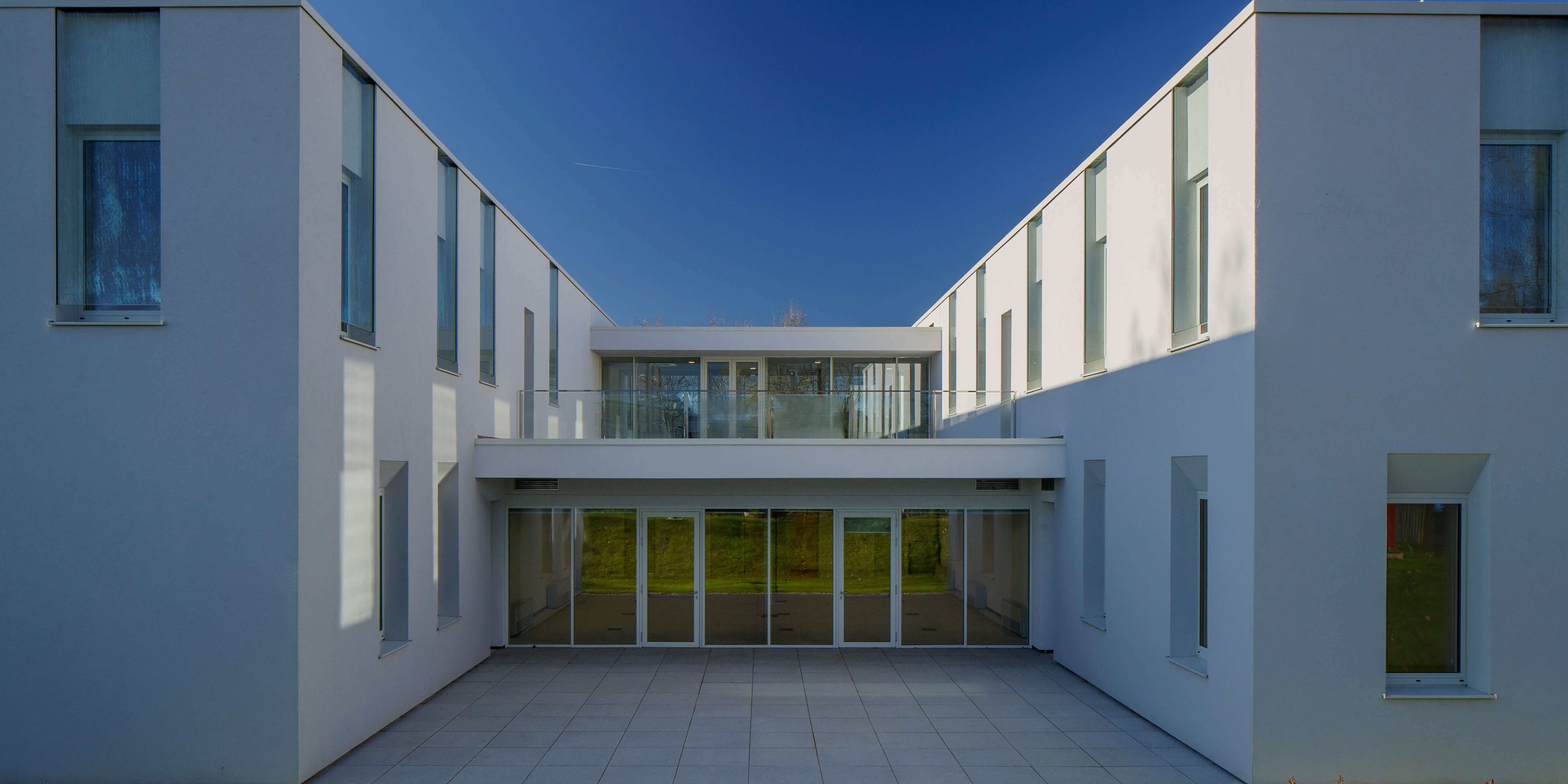
That is why infrastructure matters so much. IRB is currently carrying out O-ZIP, a capital infrastructure project worth almost €108 million, one of the key prerequisites for a new phase in the Institute’s development. The project includes the renovation and modernisation of facilities as well as the procurement of almost the Institute’s entire scientific equipment base, and it is rightly described at IRB as the biggest physical transformation since the Institute was founded.
For scientists coming from abroad, as well as for those considering a return, such signals matter greatly: they show that science is not merely a cost, but an investment in the future.
In the end, perhaps that is the main message of this story. A scientist’s departure does not necessarily have to mean a loss. Sometimes it is simply a phase of professional growth. But for knowledge to return, or for someone from elsewhere in the world to want to come to RBI, we must create a place with enough quality, ambition, and openness to make that arrival meaningful.
We hope that the Ruđer Bošković Institute is increasingly becoming precisely such a place.