
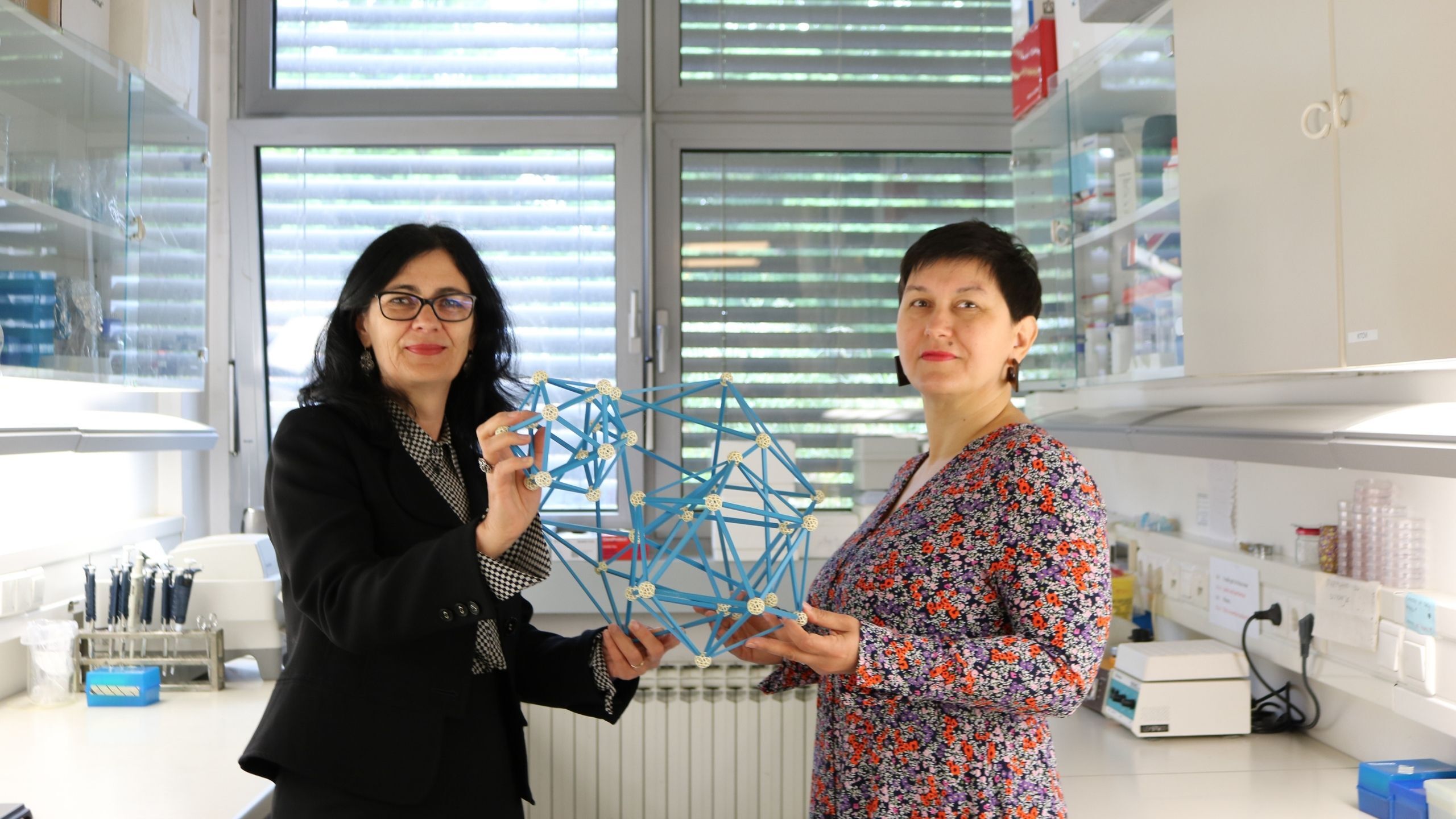
Dr Andreja Ambriović Ristov and Dr Dragomira Majhen of the Ruđer Bošković Institute devised precisely this kind of virus-hunting approach. VirusHunter is a patented diagnostic method that uses universal “VirusHunter baits” to capture any potentially pathogenic virus, without knowing in advance which virus is present. One test, all viruses, within 24 hours. Behind that concept lies more than two decades of research into virus biology, a patent that took years to overcome every obstacle, and a company they founded to bring the idea to market.
A Love of Viruses
“VirusHunter was born out of a love of viruses and my feeling that we neglect them,” says Andreja. “We lump them all together under one common label, yet every virus is different, each enters cells in its own way. In diagnostics, we treat them as if they were all the same, we run a test for one, then another, then a third. For years I kept thinking about how to design a test that would detect everything at once.” And when the time came to share the idea with someone, she turned to Dragomira, who sees VirusHunter from a different angle. “My entire career has been rooted in basic research, and I have always wanted to apply the results of my work,” says Dragomira. “At first, it was scientific curiosity, because we wanted to find out whether it would work at all. Now it is personal curiosity, can I do this? Do I know how to do this? And ultimately, where will it take me?”
“We should also mention,” Andreja adds, “that Alen Kovačević, then a graduate student, worked with us on the first VirusHunter project. We are still in touch with him today, and he shares authorship of the patent.”
Six Years of Silence
VirusHunter has existed since 2016, but that number is misleading. Between the first POC, Proof of Concept, project and the moment when things finally began to move forward, six years passed in which, on the surface, nothing seemed to be happening.
“When you add up all those years, it sounds terrifying,” says Andreja. “But after the first project and the patent application, there was a quiet period in which we kept thinking about VirusHunter, talking about it often, but there simply were no projects we could apply to with that kind of research. As soon as the opportunities appeared, we reacted.”
What they never stopped working on was the patent, which ran into every obstacle it possibly could, yet they did not give up. “With real support from the Ruđer Bošković Institute, which believed in us, we finally secured the patent in July 2025. And obtaining the patent greatly strengthens our credibility, especially in the eyes of investors,” said Andreja.
Their confidence is also reinforced by their belief in the method itself, which is based on the nature of viruses, and as Dragomira puts it, nature does not make mistakes. What they now want to find out is whether the method works well enough to become a commercial product, and that is precisely what continues to drive them forward in this story of hunting viruses.
How Scientists Became Entrepreneurs
After the patent was registered, things began to accelerate. Training through Nuqleus, the deep-tech venture builder programme of the Nikola Tesla Innovation Centre, gave them their first real insight into the entrepreneurial world. That was followed by licensing the patent from the RBI, founding the company BioDetect Solutions, taking part in the Tech Transfer programme of the Zagreb Innovation Centre, ZICER, and winning third place at the Zagreb Connect conference, along with a €5,000 prize.
VirusHunters
As they themselves say, the prize is worth far more than the money alone. “Third place at Zagreb Connect is, above all, confirmation that VirusHunter has market potential, not just scientific value,” says Dragomira. “It is also a strong validation that we, as scientists, have successfully made the transition toward an entrepreneurial way of thinking. Through this process, we learned how to structure the VirusHunter story in a way that is understandable to investors, in other words, how to communicate the problem, the market potential, and the path to commercialisation clearly, rather than focusing only on scientific excellence.”
Andreja stresses that the award reflects the work of an entire team: Ana Runtić, MSc in Molecular Biology, Dr Jelena Martinčić, Dr Lucija Ružić and Dr Mario Stojanović. “The four of them took part in the ZICER programme, and Lucija delivered the pitch presentation. That intensive work resulted in our winning third place.” The prize money is earmarked for BioDetect Solutions and will be used to develop the company’s visual identity and website.
Are Entrepreneurship and Science Two Different Worlds?
The transition from science to entrepreneurship was not a smooth one, because scientists accustomed to communicating complex concepts to colleagues, at conferences, and in teaching, suddenly found themselves in front of an audience that wanted something entirely different. Mentors in the accelerator programmes were clear, talk less about the technology, more about the customer’s problem. Dragomira says that, at first, this was difficult to accept. “It often felt as though we were back at school. It took self-discipline to accept criticism that sometimes seemed misplaced, but over time we learned how to listen.”
Yet even after they mastered the language of investors, one fundamental misunderstanding remained. Biotechnology does not operate according to the timelines the business world expects. Developing a diagnostic product takes years, while investors want results in months. “That is something I struggle with,” says Dragomira. “But it will not discourage us.”
What troubles Andreja, meanwhile, goes deeper than deadlines. “Scientists are seen as detached from the real world, and that image is false,” she says. “Innovation cannot be ordered on demand, it grows out of basic research. But I was surprised by how often those two worlds belittle one another. No one is more important, only collaboration can lead to success.” She adds, “Right now I am trying to be both, and honestly, at times that is a little difficult, because the scientist and the entrepreneur in me do not always agree.”
Twenty-Five Years Together
Andreja was Dragomira’s PhD mentor. Today they are equal partners, company co-founders, and co-authors of the patent. When asked what has kept such a collaboration together for more than two decades, their answer is, in fact, exactly what one might expect. Mutual trust, open communication, and respect for each other’s expertise. “Over the years, we have learned how best to combine our strengths and complement one another where one of us may not be as strong.

When one of us loses momentum a little, the other gives a push, and the story moves forward. Of course, both of us also have passion, that inner drive, the desire to see VirusHunter become reality. Without that, it would never work,” says Dragomira, before adding something more personal. “Andreja created all the conditions and gave me the freedom to become an independent scientist. Now, through VirusHunter, we are going through a new kind of adventure together, one that challenges us both, but at the same time rewards us immensely with new experiences.”
Andreja sums it up in her own way: “The two of us simply work well together. We are similar enough, and different enough, to complement each other brilliantly. I think the key is that we are very honest and keep nothing from one another. We are not just friends and colleagues, we are a little more than that. And that is such a wonderful feeling.”
Have They Succeeded?
The obvious question after nearly a decade of work is this: have they succeeded? The answer depends on how success is defined. They have the patent, they have founded the company, and the methodology works in the laboratory for several different viruses. VirusHunter is currently at the prototype stage, at TRL4 level, and the team is working on optimising the baits that form the core of the technology. The first testing in a real-world environment could take place in 2027, but before it can become a commercial product, it must still go through regulatory procedures and obtain certification.
So the journey is far from over.
Andreja is measured in her assessment of success: “I still would not say that we have succeeded. Only when we have a product on the market that is actually selling, that is when we will know we have succeeded.” And until then? “The VirusHunters, women hunting viruses, are becoming InvestmentHunters, women hunting investment.”
Dragomira closes in the same spirit in which she began, through curiosity: “With VirusHunter, I stepped into the world of technology transfer and opened the door to a completely new challenge. And that is what motivates me anew every single day.”