

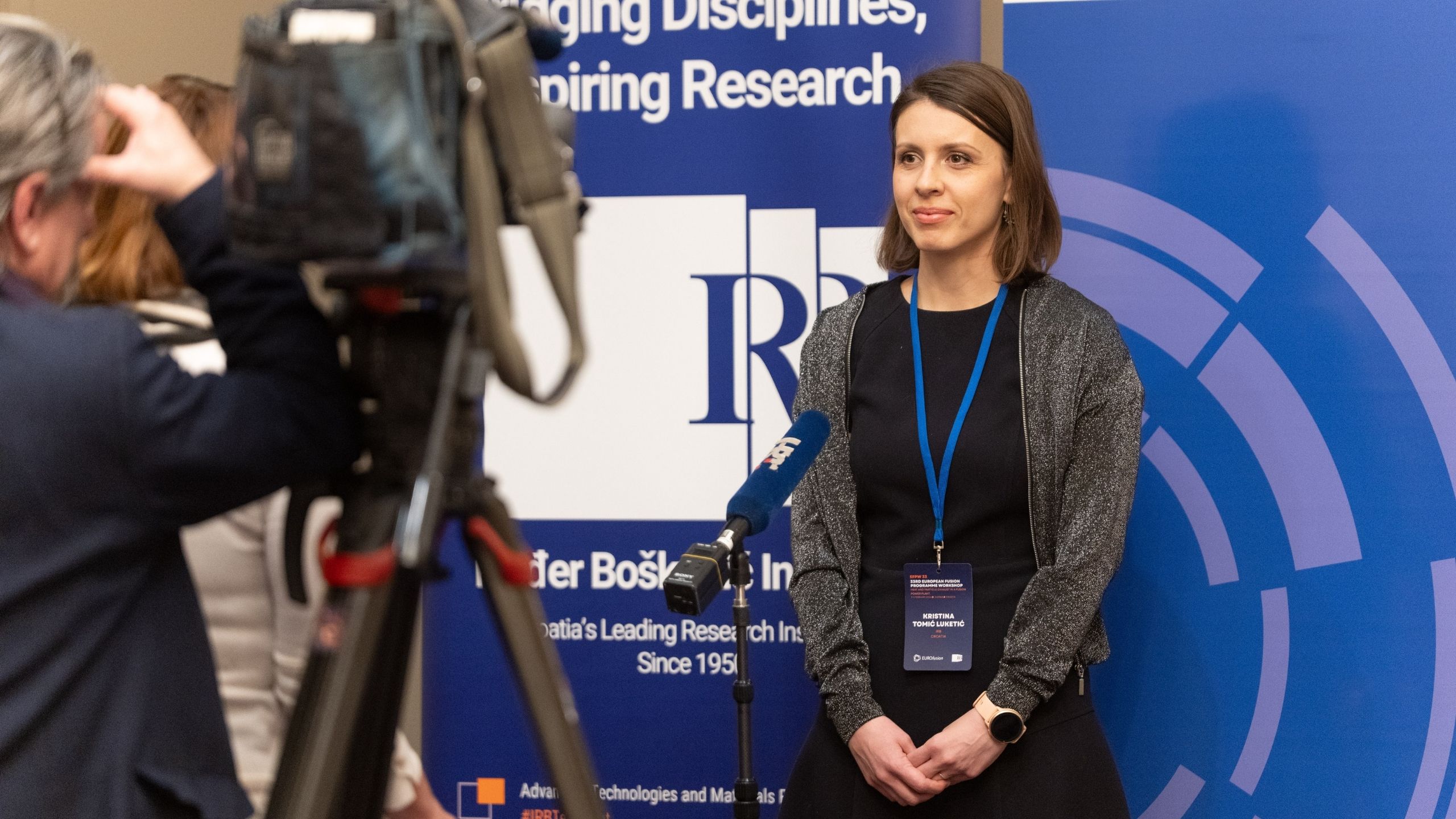
In one sentence, her work can be described like this, she is involved in the design and development of diagnostic devices for the IFMIF-DONES accelerator facility, which will be used to qualify materials intended for future fusion reactors, and in parallel she studies new materials relevant for fusion applications at the RBI accelerator center, within the Laboratory for Ion Beam Interactions.
An opportunity that rarely comes
At the beginning, what surprised her most was how revolutionary the field is, and the feeling that it is something uniquely of our time. As she says, she felt genuine excitement at being able to be part of history in the making, because such opportunities appear exceptionally rarely. She was also pleasantly surprised to see how many people across Europe are joining forces to achieve a common goal.
She is currently working mostly on Croatia’s contribution to building the IFMIF-DONES accelerator facility, a high power accelerator that will produce neutrons of the appropriate intensity and energy. This will make it possible to qualify materials for fusion applications, and also, for example, to test ways of producing tritium. At the same time, broader applications are also envisaged in other research areas, from nuclear physics and solid state physics to chemistry and mechanical engineering.
Diagnostics that safeguard key parameters
Within the project, Dr. sc. Kristina Tomić Luketić coordinates and, together with collaborators, researches and develops diagnostic devices that will be used to monitor the parameters of the deuteron beam and the liquid lithium jet in the DONES accelerator. These are components with a very concrete role, they are the last opportunity to check and measure key parameters before the interaction that generates neutrons, to ensure all desired outcomes.
In systems this complex, precise measurement and control are not an add on, they are a prerequisite for success. The diagnostic devices her team is developing make it possible to track, understand, and optimize the deuteron beam and the liquid lithium jet at the right moment, before the interaction begins. That is why their contribution is not merely a technical step in the project, but a key link in ensuring reliable conditions for neutron production and, consequently, for testing materials that could one day become part of future fusion reactors.