
Climate change has been reshaping the rules of agriculture across Europe for quite some time. More frequent heatwaves, prolonged droughts, and unpredictable rainfall are becoming a new reality that farmers must contend with. Croatia is no exception, and Varaždin County—one of the country’s key agricultural regions—has been experiencing these shifts for years. Between 2005 and 2023, drought caused economic losses estimated at €560 million.
“Amid these challenges, we launched the project Integrating Science and Tradition for Resilient and Sustainable Food Production in the Era of Climate Change – CLIMAGRIT. We want to bring together scientific knowledge and farmers’ experience to develop practical solutions. Our goal is to help agriculture remain sustainable and resilient in the decades ahead, and the key question we are seeking to answer is whether microorganisms living in the soil can help plants cope with climate change,” explains Dr Ines Sviličić Petrić, the project lead from the Division for Marine and Environmental Research.
With a total value of €583,752.84, the project is one of 19 projects in the Republic of Croatia funded under the Competitiveness and Cohesion Programme 2021–2027, through the call Strengthening Applied Research for Climate Change Adaptation Measures and Risk Management (PK.3.4.17).
Invisible Help from the Soil: Biostimulants and the Microbiome
The research team will look for solutions to plant resilience in a world invisible to the naked eye. Successful agricultural production is based on the complex interplay of three key components: the plant, the soil, and the microbiome. The plant is the food producer and the visible centre of the agricultural system, while the soil provides physical support, water, and nutrients. The microbiome, meanwhile, is the unseen but essential part of the system. This community of microorganisms—living on and inside the plant, in the soil, and around the roots—helps plants absorb water and nutrients, stimulates growth and development, and acts as a natural defence against various stressors, including climate-related stresses such as drought. Together, these three components determine crop health, yield, and quality.

Drought is one of the greatest challenges for agriculture in Varaždin County, which is why CLIMAGRIT places special emphasis on developing microbial plant biostimulants (known as plant growth–promoting microorganisms) to help plants endure dry periods more easily.
“We are not talking about genetically modified organisms or chemicals. We are talking about selected natural plant growth–promoting microorganisms that already exist in soil ecosystems; we simply prepare and apply them in a targeted way so they can help plants at critical moments,” Sviličić Petrić explains.
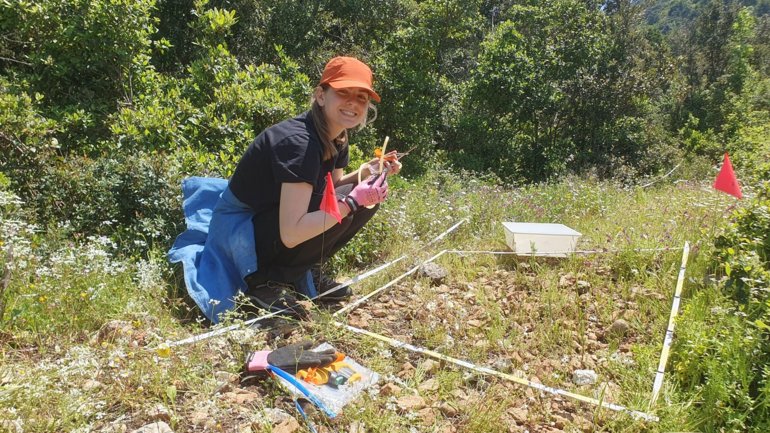
The research will begin with laboratory experiments under controlled conditions, where scientists will assess which microorganisms perform best under drought stress, followed by field research. Varaždin County, as the main partner, will ensure a strong link between the project and the local community, farmers, and development policies—among other things by selecting family farms (OPGs) that will participate as partners in field trials on real crops, with an emphasis on traditional, local varieties that are sensitive to drought. These are crops with EU designations of origin, representing a valuable part of local and national heritage, and naturally adapted to our soil, climate, and microorganisms. In an era of climate change, sustainable solutions begin locally—in the soil, in the varieties, and in the knowledge we already have.
From Weather Data to Drought Forecasting
The second part of the research focuses on developing an early-warning and drought-risk forecasting system for Varaždin County by integrating local and global data sources. Particular emphasis is placed on understanding the link between drought risk and shifts in soil microbiome composition, contributing to a deeper understanding of the ecological impacts of climate change on the “micro-world” beneath the surface and to the development of tools for informed risk management in agriculture.
Such a tool would enable farmers and local authorities to respond in time—adjust irrigation schedules, plant more resilient crops, or take other measures before drought becomes a real problem.
“Drought forecasting is not only a meteorological issue. We want to understand how climate conditions affect life in the soil, and how changes in the microbiome can be an early signal that something is shifting,” says Sviličić Petrić.
Who Are the Project Partners?
CLIMAGRIT directly builds on the PERSPIRE project (2020–2023), also funded by European resources, in which scientists developed a methodology, isolated stress-tolerant microorganisms as potential plant growth promoters, and established collaboration with key stakeholders involved in adapting agriculture to climate change.
Given the nature of the topic, the project requires collaboration across scientific fields, which is why CLIMAGRIT brings together experts from several institutions—from the Faculty of Agriculture, University of Zagreb; University North; and Josip Juraj Strossmayer University of Osijek, to the Institute for Anthropological Research. Each partner contributes unique expertise, and only by connecting these contributions is it possible to achieve a comprehensive understanding of climate change impacts on soil, plants, and agriculture.
From RBI, the project involves Dr Ines Sviličić Petrić as project lead, along with Dr Ivana Babić, Dr Maja Ivanić, and Dr Sanja Frka Milosavljević. Building on RBI’s interdisciplinary character, CLIMAGRIT brings together these scientists of different profiles in a joint study of agricultural adaptation to climate change—from microbiological research into drought impacts on soil and the development of microbial biostimulants, through investigating the role of soil type in their effectiveness, to assessing plant stress and health via volatile organic compounds.
Why Does This Matter Now?
Climate change is already affecting agricultural production in Croatia, and the Republic of Croatia’s Climate Change Adaptation Strategy identifies agriculture as one of the most vulnerable sectors. The frequency and intensity of droughts, floods, and heatwaves are increasing—along with economic losses.
“This is not a question of the future, but of the present. Farmers are already feeling the changes, yields are declining, and traditional crops that were reliable for generations are becoming uncertain. That is why we must act now,” Sviličić Petrić emphasizes.
CLIMAGRIT focuses on three climate-vulnerable sectors: agriculture (drought resilience and crop yields), health (the impact of drought on the quality of food products and, consequently, human health), and natural ecosystems (soil conservation and microbial biodiversity). The goal is to develop locally tailored solutions that work in real-world conditions, not only in the laboratory.
From Bacteria to Food Security
Can the success of this project be measured only by the number of new microorganisms identified or the accuracy of models? No. Success will be measured by whether traditional crops survive the next drought, whether small-scale farmers can plan production with greater confidence, and whether the local community has tools to respond to climate risks.
“In the end, this is about food supply security under climate change. It is a complex challenge that requires integrating science and practice, the laboratory and the field, data and experience. CLIMAGRIT is trying to do exactly that,” concludes Dr Ines Sviličić Petrić.
The total value of the project is €583,752.84, of which €496,189.89 is financed through non-repayable funding from European funds. The project will run from January 2026 to June 2029 and is implemented in cooperation with Varaždin County as the main partner.