
For most people, pollen is a seasonal sign of spring, flowering plants, allergies, and yellow traces left on windows and cars. But for scientists at the Ruđer Bošković Institute, it is much more than a springtime nuisance. Pollen is a tiny but important link between land, atmosphere, and sea. It travels through the air, settles on the sea surface, and enters a sensitive coastal ecosystem where even small changes can have wider consequences.
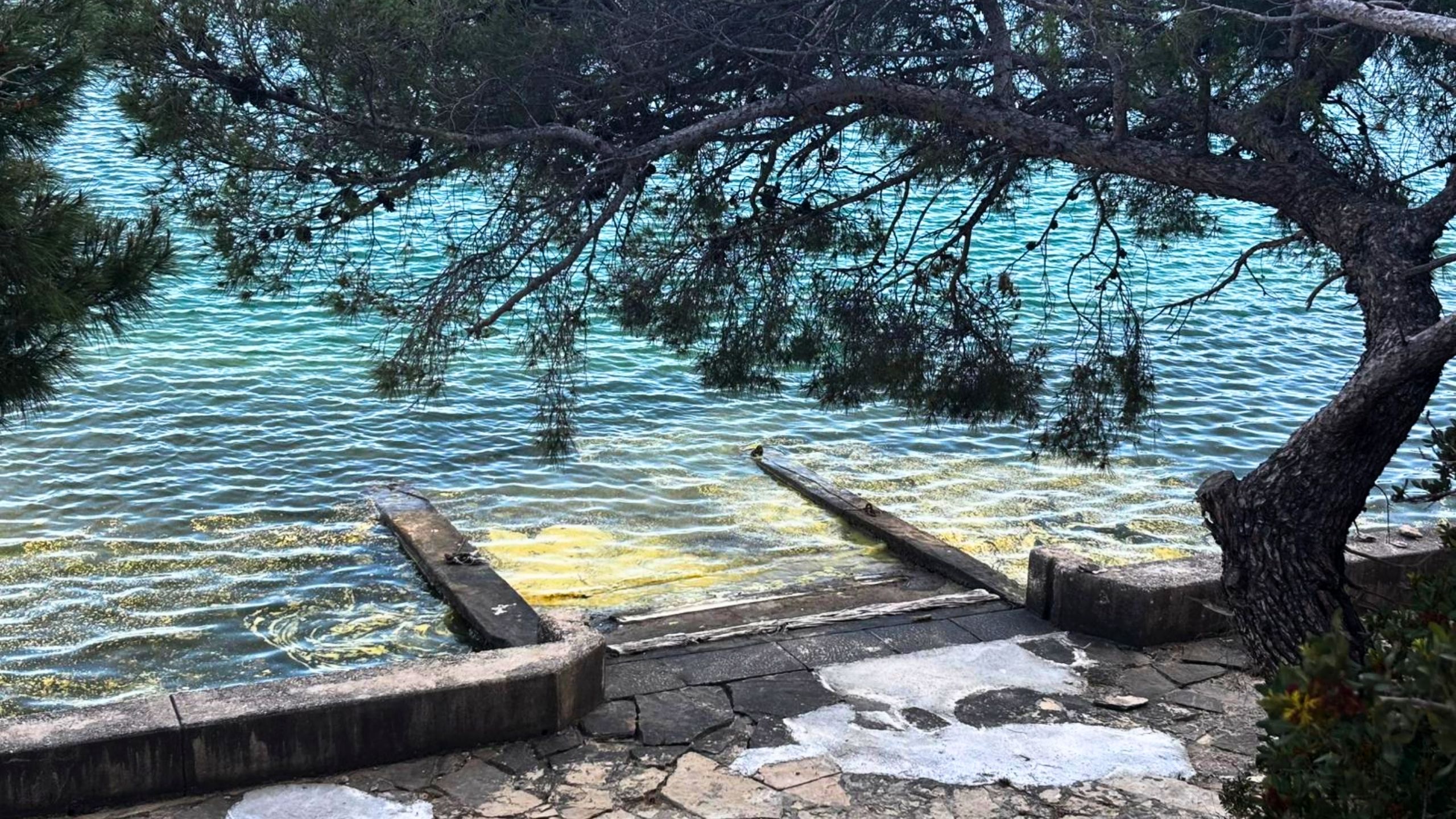
This yellow layer on the sea surface is one of the starting points of the project POLLMAR, Pollen in the Adriatic Sea: Input Dynamics, Chemical Characterisation and Impact on Primary Production, funded by the Croatian Science Foundation. As part of the project, scientists from the Division for Marine and Environmental Research at the Ruđer Bošković Institute, led by Dr Slađana Strmečki Kos, conducted a field microcosm experiment from 7 to 11 April 2026 at the Martinska Marine Research Station near Šibenik.
Pollen in the sea off Martinska
Their question seems simple only at first glance: what happens when pollen from land ends up in the sea?
Spring Entering the Sea
Pollen in the sea is not a new phenomenon. People living along the coast have long noticed yellow patches appearing on the surface of the Adriatic in spring and early summer. But what may once have been seen as a short-lived natural occurrence is now gaining new scientific significance.
Climate change affects the duration and intensity of pollination seasons, alters flowering patterns, and increases scientific interest in all processes that connect the atmosphere and the sea. Pollen grains carried by the wind settle on the sea surface, where they do not remain merely a passive trace of the terrestrial landscape. They can release organic matter, nutrients, and substances that have attached to them during their journey through the atmosphere.
Of particular importance is the sea surface microlayer, the thinnest layer at the boundary between the sea and the air. Although almost invisible, it is an extremely dynamic environment where the atmosphere, sunlight, organic matter, microorganisms, and land-derived substances all meet.
Nenad Muhin, collecting seawater for incubation
“Our previous research in the Šibenik area showed that the sea surface microlayer, the thinnest and most sensitive layer at the air-sea interface, is enriched with pollen grains that are mostly of local and regional origin. In 2024, we identified as many as 89 different pollen types in this layer. Particularly interesting is the fact that, in March of the same year, we found 205,000 pollen grains in just one litre of water from the sea surface microlayer, mostly pine and cypress pollen.
These results change the way we look at what may seem like an ordinary spring scene. A yellow sea surface is no longer just a visual curiosity, but a sign of intense exchange between land, atmosphere, and sea. That is precisely why we want to understand what happens to pollen once it enters the marine environment, and how it may affect the chemical and biological processes in the coastal ecosystem of the Adriatic,” says Dr Slađana Strmečki Kos, principal investigator of the POLLMAR project.
Small Models of the Adriatic
To find out what happens to pollen once it reaches the sea from land, scientists at Martinska created small “pocket-sized” versions of the Adriatic. They placed seawater and pollen into special incubation bags, then submerged them back into the sea so that, for several days, they would experience the same sunlight, temperature, and rhythm of the waves as the surrounding environment.
Terezija Galeković, Andrea Milinković, Slađana Strmečki Kos and Hrvoje Vojvodić, preparing the incubation
The story began on land, among pine trees. Pollen from Aleppo pine (Pinus halepensis), one of the characteristic species of the Mediterranean landscape, was collected from nearby trees. This is precisely the type of pollen that is often carried by the wind in spring and ends up on the sea surface. At the same time, seawater was sampled between Jadrija and the island of Prvić and transported to the Martinska research station.
There, the scientists prepared 12 incubation bags. Each was filled with seawater, followed by different amounts of pollen, allowing the team to observe what happens when there is more or less pollen in the sea. The bags were then secured in a special cage and submerged in the sea, where they remained exposed to natural light and temperature for five days.
In these small, enclosed marine worlds, the scientists observed a much larger question: does pollen change the sea? Does it release substances that feed or alter microbial life? Can something that begins as a yellow spring trace on the surface trigger changes in the invisible but crucial life of the coastal Adriatic?
Fieldwork Behind Laboratory Results
Field science is often less spectacular than we imagine, but its strength lies precisely in its precision. Behind every future graph is a carefully executed sequence of steps, from sampling, transport, incubation, filtration, and preservation to sample processing.
During the five-day experiment, the research team regularly collected water from the incubation bags to monitor changes in physical, chemical, and biological parameters. They paid particular attention to the composition of organic matter, because this can reveal what pollen releases into the marine environment and how these substances later become part of biogeochemical processes.
Andrea Milinković, processing samples in the laboratory at Martinska
Some samples were analysed immediately, while others were preserved for further laboratory processing. This approach allows scientists to track changes over time, from the first contact between pollen and seawater to the later responses of the system.
Members of the research team took part in different stages of the experiment. Terezija Galeković and Andrea Milinković participated in sampling pine pollen, Tomislav Bulat and Nenad Muhin collected the seawater for incubation, Terezija Galeković and Hrvoje Vojvodić prepared the incubations, Tomislav Bulat secured the incubation bags in the cage, while Nenad Muhin and Hrvoje Vojvodić sampled the microcosms. Andrea Milinković, Terezija Galeković, Blaženka Gašparović, and Slađana Strmečki Kos continued processing the samples in the laboratory at Martinska.
This is the less visible side of science: hands in the water, equipment in the field, notes, samples, and repetition. Only after that come the data that can change our understanding of an ecosystem.
Why Does This Matter?
The Adriatic is a sea we often experience through beauty, tourism, and the coast. For scientists, however, it is also a sensitive biogeochemical system. The central Adriatic and the wider Mediterranean are naturally poor in nutrient salts such as nitrogen and phosphorus. Under such conditions, even additional inputs of substances from the atmosphere can become important.
Pollen is particularly interesting because it brings land-derived material into the marine environment. When it comes into contact with seawater or brackish water, a pollen grain can rupture and release various organic compounds. These compounds can become available to microorganisms, influence the composition of dissolved organic matter, and alter conditions for primary production.
Primary production is the foundation of marine life. It begins with microscopic organisms that use photosynthesis to create organic matter, thereby setting the food web in motion. If the availability of nutrients or the composition of organic matter in the surface layer of the sea changes, the consequences may spread further through the ecosystem.
This is why pollen research is not a narrow question of a seasonal phenomenon on the sea surface. It concerns the way coastal ecosystems respond to changes in the atmosphere, vegetation, and climate.
A Project at the Intersection of Disciplines
POLLMAR brings together knowledge from atmospheric chemistry, aerobiology, marine biogeochemistry, and oceanology. The project does not view pollen solely as biological material, but as part of a broader cycle in which land, air, and sea are constantly connected.
The project investigates the dynamics of pollen input into the coastal waters of the central Adriatic, chemical biomarkers of pollen in the atmosphere and the sea, the behaviour of pollen grains in seawater and brackish water, the organic matter released in the process, and potential impacts on nutrients and primary production.
The project is led by Dr Slađana Strmečki Kos, and the research team brings together scientists from the Ruđer Bošković Institute and collaborators from Croatia, Portugal, and Poland. This collaboration reflects the complexity of the topic, because understanding what happens to pollen in the sea requires an understanding of plants, the atmosphere, chemistry, microorganisms, and marine processes at the same time.
What Does a Yellow Sea Surface Tell Us?
Major scientific questions often begin with a scene that is easy to overlook. A yellow sea surface may seem like a brief spring episode that will soon be broken up by wind or waves. But for researchers, it is a trace of processes connecting Aleppo pine forests, atmospheric currents, and microscopic life in the sea.
The experiment carried out off Martinska will help scientists determine more precisely how pollen affects the physical, chemical, and biological properties of seawater. The results will contribute to a better understanding of the role of pollen as a land-derived source of organic matter in the Adriatic, as well as to assessing its possible impact on Mediterranean coastal ecosystems.
In a time of climate change, such research is becoming increasingly important. It does not offer simple answers, but it builds the knowledge we need in order to better understand the sea before changes within it begin to appear on a larger scale.
Because sometimes the future of an ecosystem does not announce itself dramatically. Sometimes it appears quietly, in early April, as yellow dust on the surface of the sea.