
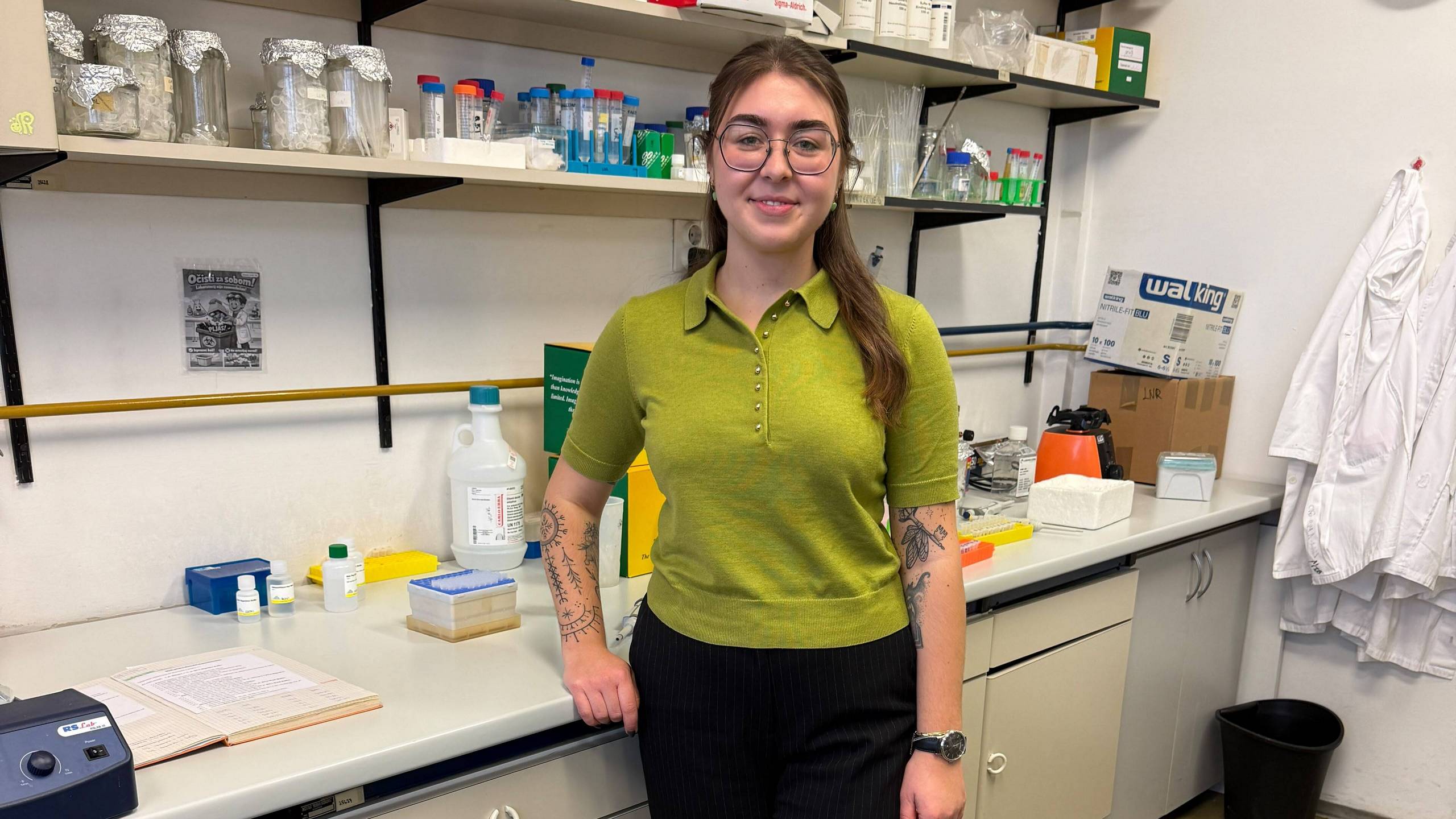
At this year's Congress of the Croatian Society of Biochemistry and Molecular Biology (HDBMB 2026) in Dubrovnik, her research earned her the FEBS Open Bio Poster Award for the best poster. The award is presented by FEBS Open Bio, a journal of the Federation of European Biochemical Societies (FEBS).
But there is much more to Lea's story. Outside the laboratory, she runs half-marathons, crochets and bakes Christmas biscuits that her colleagues start asking about as early as November.
Asked to describe herself without mentioning academic qualifications or scientific publications, Lea says she is an open, straightforward person with a good sense of humour and plenty of hobbies. She enjoys spending time with friends but also values her peace and quiet.
“I love cooking, especially for other people. I enjoy life's little pleasures, and I'll always stop to say hello to dogs and cats I meet in the street,” she says.
An Artist or a Scientist?
As a child, Lea was curious and creative, constantly inventing stories and fascinated by animals and nature. Whenever someone asked what she wanted to be when she grew up, she had one of two answers: an artist or a scientist.
“I loved drawing, although perhaps I wasn't particularly talented at it. So my other ambition, becoming a scientist, eventually won out,” she recalls.
She grew up in Babonićeva Street in Zagreb, and walks with her parents and friends often took her past the Faculty of Science on Horvatovac. Even then, she would declare that one day she would study there. And she kept her word.
At secondary school, she was torn between biology and chemistry, but her desire to understand the living world, particularly animals, ultimately tipped the balance towards biology.
“Although I used to imagine myself doing fieldwork and studying the behaviour of lions in Africa, during my studies I discovered the beauty of laboratory research and cellular and molecular biology. I realised that working in a laboratory suited me better than fieldwork,” she explains.
Studying biology at the University of Zagreb's Faculty of Science took her through the extraordinary diversity of life, from plants, algae and protists to invertebrates and vertebrates. Along the way, it opened up an entirely new world of laboratory research and cellular and molecular biology.
“Thanks to my natural curiosity, I could find something interesting in almost every lecture, although perhaps a little less so in botany,” she admits. “But what fascinated me most was how processes taking place on such a tiny, molecular scale make it possible for an entire cell, and ultimately a whole organism, to function.”
Her student years also brought an award for academic achievement, volunteering with the Green Guard programme at Plitvice Lakes National Park in 2019, and helping to deliver workshops on bees and bioacoustics during Biology Night.
The lions may have remained in Africa, but Lea's curiosity about the living world had simply shifted to a different scale.
An Unusual Route into Mitochondria
Most of us remember mitochondria from secondary-school biology as the 'powerhouses of the cell'. But most of the proteins that work inside these organelles are not actually produced there. Instead, they are made in the cytoplasm and must somehow be transported to the right destination.
Most of these proteins carry a special targeting sequence, a short stretch of amino acids that acts as a molecular address label, telling the cell that the protein needs to be imported into a mitochondrion.
NME6 lacks this conventional signal. Yet somehow, it still reaches mitochondria.
How?
That is the question at the heart of Lea's research.
Her supervisor, Dr Maja Herak Bosnar*, has been studying NME6 for years, and the gene itself was discovered more than two decades ago. Nevertheless, Lea explains, much remains unknown about the protein, from how it enters mitochondria to what it actually does and why it matters to the cell.
“I'm aware that it's impossible to answer all these questions during my PhD, but I'd love to at least scratch the surface and contribute to a better understanding of its function,” she says.
She is currently looking for proteins that interact with NME6. In other words, she is trying to discover which other proteins NME6 'hangs out with' and whether any of them might help it find its way.
A Eureka Moment in a Dark Basement Room
The first major challenge of Lea's PhD was to identify which regions of the NME6 protein are important for its entry into mitochondria.
She investigated these regions in living cells using a confocal microscope. Getting a good image required extensive optimisation, experimenting with different settings, plenty of patience and the hope that the cells would be 'happy' and looking their best on the day of imaging.
She spent hours in a dark basement room in Wing V of the Institute, alongside her colleague Lucija Horvat, who works with the microscope and was just as eager to find clear, beautiful signals.
Eventually, their patience paid off. The images clearly revealed which regions were essential for the localisation of NME6 to mitochondria.
“Every good result you've been waiting a long time for brings enormous satisfaction and happiness, especially when it's something as visually striking as images of cells captured with a confocal microscope,” Lea says.
The Award Her Colleagues Saw Coming
This year, those results also earned formal recognition.
At the HDBMB 2026 Congress in Dubrovnik, Lea received the FEBS Open Bio Poster Award, her first research award in the two years since beginning her PhD.
Shortly before the announcement, two colleagues and friends had confidently predicted that she would win.
“I thought it was hilarious, but they were absolutely convinced. And in the end, they were right,” she recalls.
When her name was announced, she was momentarily bewildered, but quickly gathered herself and stepped forward to collect the award.
Just a minute later, the celebrations doubled when her colleague Nikolina Vučemilo Paripović received another poster award.
“Besides the wonderful feeling of having my work recognised, an award like this gives me extra motivation and reassurance that I'm on the right track.”
Repeat, Adjust, Repeat Again
Anyone shadowing Lea for a working day would quickly discover that a scientist's life involves considerably more movement than standing quietly at a laboratory bench in a white coat.
The first surprise would probably be the number of steps she takes.
Her desk is in the attic of Wing V, while the laboratory is on the second floor. Between trips up and down the stairs, moving from one fridge to another and between different pieces of equipment, she rarely stays in one place for long.
“I'm constantly on the move,” she says.
The second surprise would be the sheer amount of preparation involved.
“A good plan is worth its weight in gold.”
That includes carefully labelling countless small plastic sample tubes, known in the laboratory as Eppendorf tubes or 'Eppis', so she can keep track of everything during an experiment and still make sense of the results two months later.
Students arriving for internships or dissertation projects are often surprised by something else: the story does not end with a single successful result.
Experiments need to be repeated at least two or three times to establish that the data are reliable. If something fails, the experimental conditions have to be adjusted and the whole process repeated, sometimes again and again. Finally, all the results must be analysed and brought together into a coherent scientific story.
“In science, the work doesn't end when you get one good result. Quite often, that's when it really begins.”
Lea admits that learning to deal with failure is still a work in progress.
Her colleagues sometimes tell her she is too much of a perfectionist, repeating an experiment until she obtains what she considers the 'perfect' image.
This summer, she spent weeks optimising and repeating co-immunoprecipitation, a technique used to investigate interactions between proteins.
“I think my colleagues were even happier than I was when I finally got good results and stopped using that method, at least for a while.”
One piece of advice from her supervisor has helped put things into perspective: a result that is 100 per cent perfect does not exist, and an image that is 80 or 90 per cent perfect is perfectly good enough.
“That really comforted me. I remember it every time the signal on a membrane isn't perfect.”
When it comes to collaboration, Lea believes the most important contributions are not necessarily the major partnerships listed in project proposals or scientific papers.
Often, they are the small, everyday gestures: a colleague who answers a question, lends a chemical reagent or prepares a gel when she is running short of time.
“You can always hear us 'young ones' on our floor, the PhD students and postdocs. We joke around, greet each other loudly, help one another, complain and offer encouragement. They make every working day easier and more enjoyable.”
Mitochondria Are More Than Cellular Powerhouses
Lea's work belongs to the field of fundamental biological research, but its significance extends beyond understanding a single protein.
“We now know that the classic phrase 'mitochondria are the powerhouse of the cell' captures only part of the importance and functions of these organelles,” she explains.
Mitochondria are involved in numerous signalling pathways and cellular processes, and disruptions to their function have been linked to a range of diseases.
A better understanding of the role of NME6 could therefore reveal molecular mechanisms that are important for normal cellular function, as well as processes that go wrong in certain diseases.
One Step at a Time
After work, Lea often swaps her laboratory shoes for running trainers.
She started running almost by accident nearly two years ago, after spotting an Instagram advert for a running school and deciding to sign up.
Having always considered herself rather unsporty, she began without any particular expectations. But gradually, she improved and discovered that she genuinely enjoyed running.
Today, she trains every week with Forca Athletics Club and her running companions in 'Group 5'.
“Running has become my way of letting off steam. I think about everything and nothing, somehow reset my mind, clear away my problems and focus entirely on the path ahead.”
At the 2025 B2Run race, she represented RBI and completed the course in 28 minutes and 55 seconds.
This year, the race coincided with the congress in Dubrovnik, where she was busy winning an award instead. She hopes to return to B2Run in 2027.
In the meantime, she has completed her first half-marathon on the island of Vis, at an event organised by her running club, and repeated the achievement in October at the Zagreb Half Marathon.
“When it comes to running, your mindset is what matters most, especially over longer distances. Running builds mental strength, and you reach your goal one step at a time.”
It is hard not to notice how well the same principle applies to a PhD.
Crochet, Fantasy Novels and Chocolate Crinkle Cookies
Running is far from Lea's only interest.
She also loves reading, particularly fantasy novels, although joining RBI's Book Club has encouraged her to explore other genres.
“Reading gives me an escape into another reality, while also allowing me to question my own assumptions, learn something new and reflect on life.”
Something that might surprise many people is that Lea also crochets.
She took it up during the pandemic while still at university, looking for something creative to do with her hands while attending online lectures from home.
She taught herself through YouTube tutorials, progressing from her first rather uneven scarves to making blankets and clothes for herself and the people she loves.
“Crocheting has become a kind of meditation for me, a time when I can switch off my thoughts and concentrate entirely on what I'm making.”
Then there is the kitchen.
Among her colleagues, Lea has become particularly well known for her Christmas baking. As the festive season approaches, the familiar questions begin: when is she bringing in her chocolate crinkle cookies?
“They're chocolate biscuits, and I can say, without any false modesty, that they're the most delicious ones around and that nobody makes them better than I do.”
For peace and quiet, she retreats to her family's weekend cottage in Mali Potočec, near Križevci, the village where her grandfather was born.
It has been her refuge since childhood. There, she spends weekends with her family and her dog, Bongo.
Physical work in the garden and orchard, particularly mowing the grass, helps her release frustration and forget the worries of everyday life.
Everything Will Fall into Place
What keeps Lea motivated?
“Above all, it's my personal curiosity, the desire to discover something new, something nobody has known before. There's also a sense of responsibility towards my work, but most days, what really drives me is the excitement that I might be the person who discovers something new.”
Looking ten years ahead, she hopes that at least some of the unanswered questions surrounding the function and importance of NME6 in mitochondria will have been resolved.
And, she adds, it would be wonderful if her own research had contributed to those discoveries.
As for where she herself might be in a decade, she is reluctant to make predictions.
“Sometimes I can barely plan for next week,” she admits.
“I hope I'll be doing something that interests me, where I can explore new things and push the boundaries of knowledge. Whether that's in science or somewhere else, only time will tell.”
Her advice to her younger self, just beginning university, could apply equally well to anyone standing at the beginning of their own journey:
“Everything will fall into place. Be open to new experiences, worry a little less and enjoy yourself.”
The NME6 protein reaches mitochondria by an unconventional route. In a way, Lea seems to be finding her own path in much the same way: one step at a time, with patience, persistence and an abundance of curiosity.