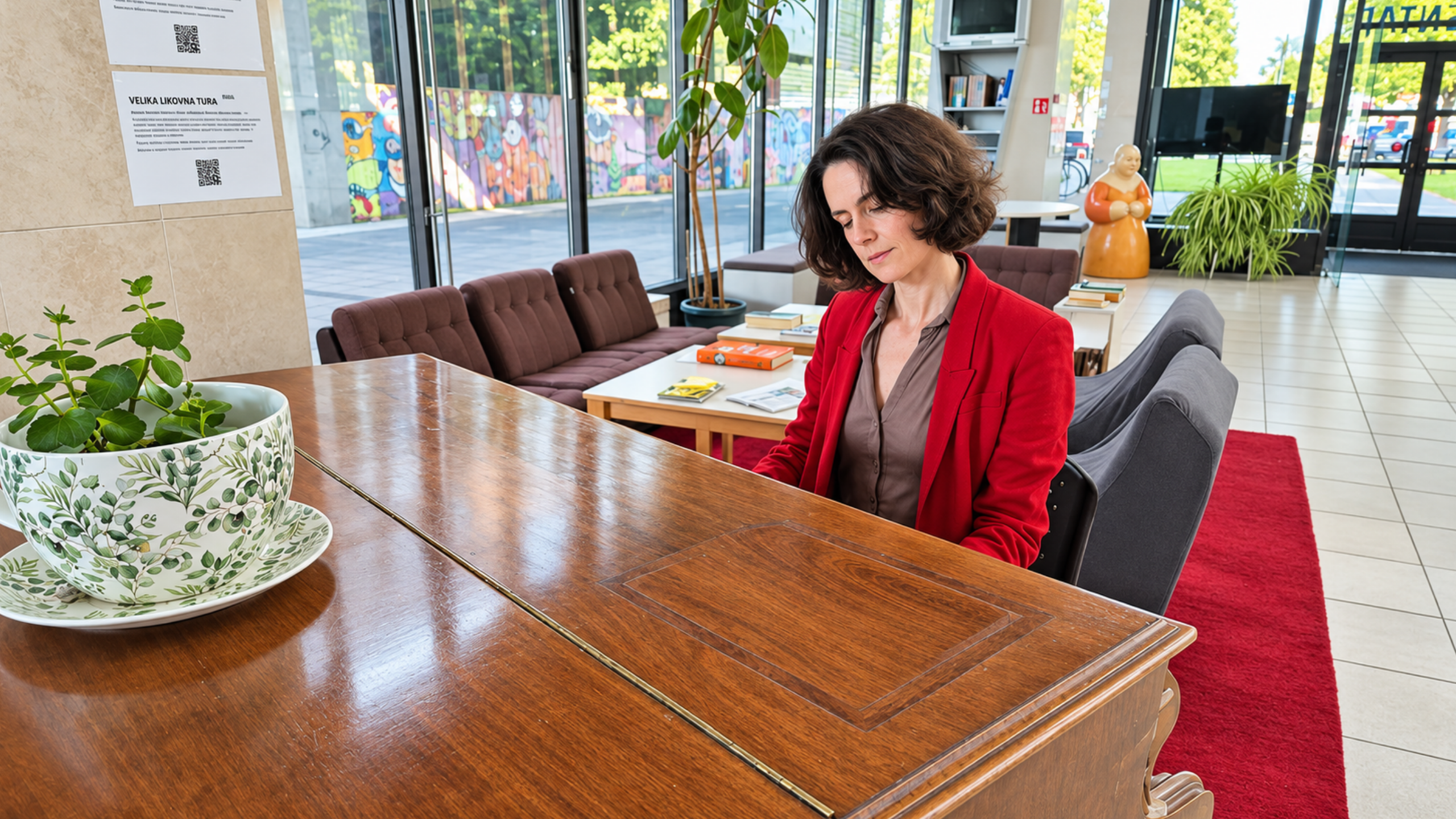
Imagine sitting at a piano in a concert hall. There is no sheet music in front of you. You have to know the piece by heart, your hands are sweating, and the audience is waiting for the first note. If you make a mistake, there is no stopping or starting again.
For Dr Antica Čulina, a researcher at the Ruđer Bošković Institute (RBI), those performances proved to be the best possible preparation for everything that followed.
“When you perform at a concert, you have no sheet music. You have to know your piece by heart, your hands are sweating from nerves, which makes playing even harder, and there are all these people listening while you're up there alone with the piano. Now that was real stage fright. Nothing I've done since has come close to being that stressful,” she recalls.
These days, she gives lectures, speaks to audiences and presents research aimed at changing how science works, with little of the anxiety she once experienced on stage. Yet the piano has never ceased to be an important part of her life.
Asked to introduce herself without mentioning her titles or professional roles, she says she would begin by saying she is Nina's mother. Then she would talk about her love of playing the piano, composing music, animals and walking in nature. Only after that would she mention being a scientist.
And it was curiosity that led her from studying the romantic relationships of birds to an unusual research question: can we use scientific methods to investigate how good science itself really is?
How Birds Exposed the Weaknesses of the Scientific System
Antica's scientific journey began in ecology. After studying in Zagreb, she completed a PhD in zoology at the University of Oxford before continuing her career at the Netherlands Institute of Ecology.
She was fascinated by the social relationships of birds. Why do some stay with the same partner while others switch mates? How do these relationships affect reproductive success?
Answering such questions requires data collected over many years, sometimes even decades. But during her PhD, Antica began noticing that many scientific papers lacked sufficient information to verify their findings, while the underlying data were often unavailable to other researchers.
“Interestingly, until my PhD, I had been living under something of an illusion that science was perfect. That changed during my doctoral research,” she admits.
She began asking why scientific papers sometimes contained contradictory information about how studies had been conducted, why certain results were incompletely described, and why obtaining the data behind published conclusions could be so difficult.
Around 2016, she started investigating these problems more systematically. A few years later, she discovered that her growing research interest had a name: metascience, the scientific study of science itself.
Antica explains the concept through an analogy with traffic.
“Someone designs a city's road network, with intersecting streets, traffic lights and roundabouts. That system allows vehicles to move around and serves an essential purpose, but it also has its problems.”
Just as traffic engineers investigate why congestion develops at particular junctions, Antica studies where and why the scientific system encounters obstacles.
“My job is to identify those trouble spots, understand what causes the problems, and propose and test solutions to make the traffic flow better and more efficiently.”
More Than 120 Researchers and One Big Idea
One of Antica's most significant achievements has been SPI-Birds, an international initiative bringing together data from long-term bird studies around the world.
Rather than allowing information collected over decades to remain scattered across individual laboratories, the aim was to bring these datasets together, harmonise them and make them available for new research.
Under her leadership, more than 120 researchers agreed to share their data. Yet the greatest challenge was not technological.
“Trust is always essential. If you build an infrastructure that nobody wants to use because there is no trust, then you haven't achieved anything,” she explains.
Working on SPI-Birds also transformed her understanding of open science. Initially, she wondered why researchers couldn't simply share their data. Today, she recognises that the decision is far from equally straightforward for everyone.
A large research group with secure, long-term funding has much less to lose by sharing its data than a small laboratory whose future may depend on its next few publications.
“Talking to researchers made me realise that the cost isn't the same for everyone,” Antica says.
That is why she believes encouraging researchers to share their data is insufficient unless the scientific system also recognises and rewards the effort involved.
SPI-Birds has received international recognition and, according to Antica's scientific profile, helped inspire the development of the Open Science Fund programme in the Netherlands.
For her personally, launching the initiative also meant taking a considerable career risk.
“My risk was spending time establishing SPI-Birds instead of publishing scientific papers.”
Why Accessible Data Aren't Always Useful
Imagine someone handing you thousands of pages of valuable information, but without explaining what the numbers mean or how they were collected. The data are available, yet you may be unable to do anything meaningful with them.
This is precisely what often happens in science.
“We're currently conducting a survey to understand why people don't use existing open data,” Antica explains.
She suspects two factors will prove particularly important: researchers often do not know where to find the data, and when they do find them, the documentation is frequently so poor that the information cannot be used.
Sometimes, the problem is as simple as an empty cell in a spreadsheet. Does it mean the information was never collected, that the value does not exist, or that it is irrelevant?
Antica offers a straightforward piece of advice: give your dataset to a colleague who is unfamiliar with it and see whether they can understand it without having to ask additional questions.
Today, at the Ruđer Bošković Institute, she leads EcoOpen, a project funded by the Croatian Science Foundation. Together with her research group, which includes PhD researchers Anita Tarandek and Renato Vidić, and postdoctoral researchers Danijela Žanko and Mariasole Calbi, she investigates how to improve the quality of ecological research and enable more effective reuse of existing data.
At the same time, she has not abandoned ecology. Her group also investigates specific ecological questions, including the effects of human activities on birds and the impacts of pharmaceutical substances on freshwater organisms.
Equally important to her, however, is establishing whether open science practices genuinely lead to better research outcomes.
“Within my group, that's exactly what we're investigating: whether, and under what circumstances, open practices actually improve science.”
For Antica, openness is not an end in itself. The ultimate goal is better research, more reliable conclusions and knowledge that can be reused, particularly when trying to understand complex challenges such as climate change and biodiversity loss.
Dr Antica Čulina with colleagues Dr Tin Klanjšček and Dr Marija Purgar.

dr. sc. Antica Čulina i kolege dr. sc. Tin Klanjšček i dr. sc. Marija Purgar
Science Should Reward Quality, Not Just Publication Counts
If scientific success is judged primarily by the number of papers published and the prestige of the journals in which they appear, why would a researcher spend months preparing a dataset for someone else to use?
Antica believes the scientific system should place greater value on research transparency, good data management and other practices that strengthen the reliability of scientific findings.
That does not mean she supports penalising researchers who fail to meet openness expectations.
“Penalties and mandates often lead to people doing things simply to tick a box, without bringing about any meaningful change,” she explains.
Instead, she advocates a system that rewards good research practices while providing scientists with practical support, from data management specialists to better training in research methods.
She acknowledges that change will be difficult. The scientific system has been shaped by decades of established funding, publishing and research assessment practices.
Nevertheless, organising an international symposium on research quality in Žumberak showed her that many people want a different kind of system.
“Without a community that wants change, it certainly won't happen. Of course, having a willing community doesn't necessarily mean change will follow. There are so many systemic barriers in science, publishing and research evaluation that have been around for so long, they're difficult to overcome. But I'm optimistic.”
She Followed Her Dreams. And Took the Risk.
Perhaps the most important decision in Antica's career was not about a scientific discovery at all. It was about deciding what she truly wanted to do.
While working in the Netherlands, as a single mother without a permanent position, she found herself facing three options.
She could continue in behavioural ecology, a field in which she had already built a strong academic track record. She could pursue metascience and open science, which increasingly fascinated her but offered a far less secure future. Or she could leave science altogether.
It was then that a more senior colleague offered advice that would prove decisive.
“There's no point doing something you're not interested in, because you'll never be as good at it as you would be at something you genuinely care about,” she recalls him saying.
She decided to take his advice.
“Despite all the warnings that you can't start something completely new and still expect to find a job and secure funding, somehow I managed it. So now I'm doing what I love.”
Today, she tries to pass that sense of freedom on to researchers at the beginning of their careers.
“It's become really important to me to help people pursue what interests them and give them opportunities to continue their education, but also to broaden their horizons, beyond education and careers to life more generally.”
Asked what she would play when a project receives funding, she answers without hesitation: Mozart's Piano Sonata in C major, K. 545.
And when the project is successfully completed? Debussy's Clair de lune.
What if the funding application is rejected?
The answer is Gangsta's Paradise.
And although she has found her place in science, the piano remains her other great passion, perhaps even an alternative life plan.
“A little part of me still says, leave science and go into music. I'd teach piano and compose,” she admits.
Behind that sense of humour is a scientist determined to question the rules of the system in which she works, as well as her own assumptions about how that system should operate.
Her mission goes beyond making scientific data openly accessible. She wants to ensure that we can extract more knowledge from those data and that the time and effort invested in collecting them do not go to waste.
Because the next major scientific discovery may begin with a fresh look at data we already have, rather than a new experiment.
Follow Your Dreams. Do What You Love!
Asked about the best advice she has ever received, and who gave it to her, Antica replies:
“This may sound like a cliché, but it really happened. The advice was to follow your dreams. At the time, I was living in the Netherlands, still without a permanent job, and raising my child as a single mother. I had three options: continue working in behavioural ecology, where I already had a strong CV; pursue what genuinely interested me, metascience and open science, where my chances of securing funding were much lower; or leave science altogether.
“Then a former colleague of mine, who had become a more senior researcher, happened to visit my institute. We talked, and he told me there was no point in doing something I wasn't interested in, because I would never be as good at it as I would be at something I genuinely cared about.
“So I took his advice. And it worked out. I'm doing what I love,” Antica concludes.