

Nobel Prize-winning physicist Prof. John Martinis: “From prehistoric qubits to building a useful quantum computer”
The visit of Nobel Prize-winning physicist Professor John Martinis to the Ruđer Bošković Institute marks an important occasion for Croatia’s scientific community and a valuable opportunity to engage with one of the world’s leading pioneers of superconducting quantum computing.
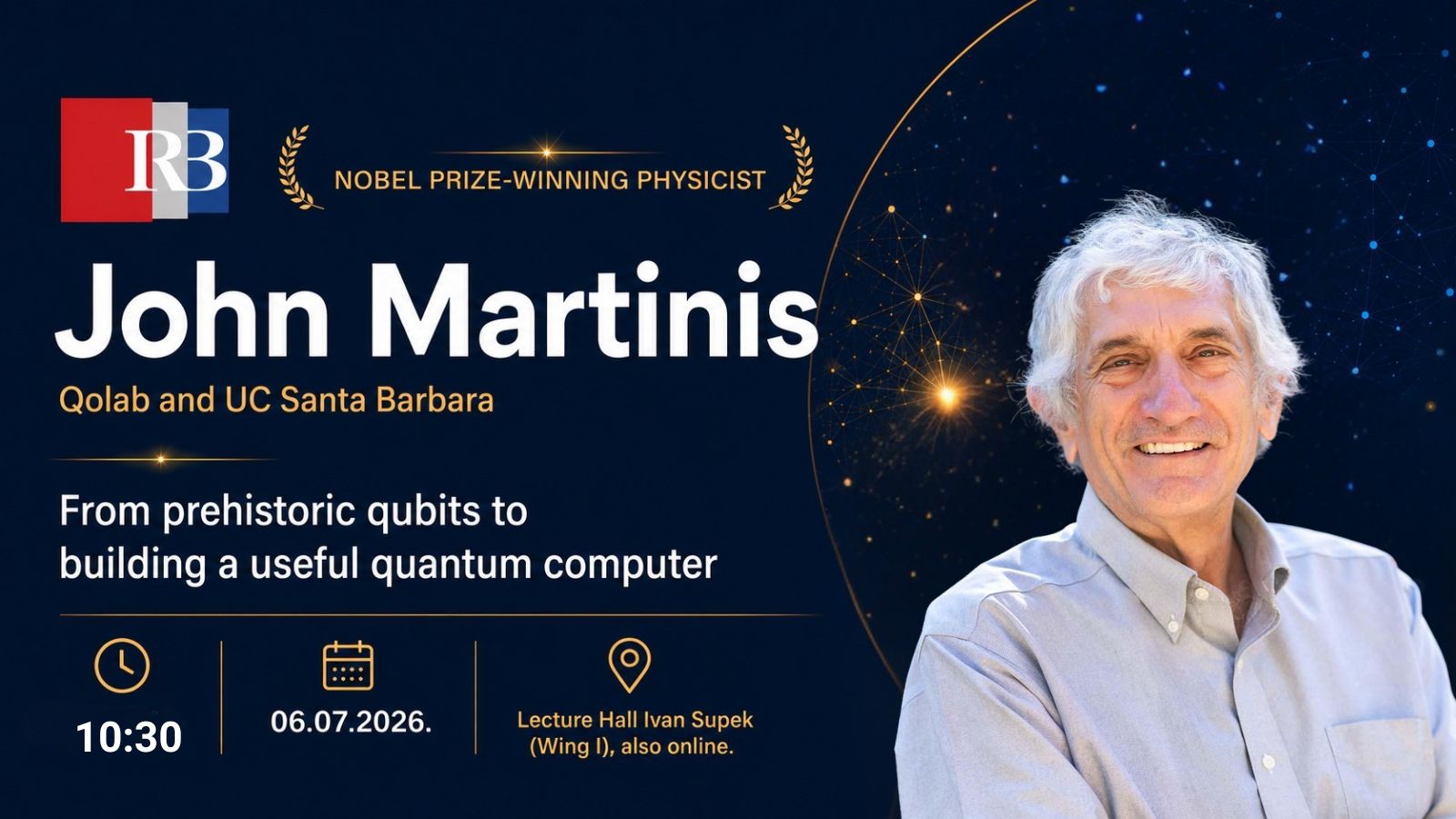
The Ruđer Bošković Institute is honoured to host Prof. John Martinis, Nobel Prize-winning physicist, Professor Emeritus at the University of California, Santa Barbara, and Co-founder and Chief Technology Officer of Qolab.
On this occasion, Professor Martinis will give a lecture titled “From prehistoric qubits to building a useful quantum computer”, which will take place on 6 July 2026 at 10:30 in the Lecture Hall Ivan Supek, Wing I.
Professor Martinis is widely recognised as one of the pioneers of superconducting quantum computing. He is a Nobel Prize-winning physicist and Professor Emeritus at the University of California, Santa Barbara. His foundational work demonstrated macroscopic quantum tunnelling and energy quantisation in superconducting electric circuits, and he later became one of the leading pioneers of superconducting quantum computing, including major experimental work at Google Quantum AI and the development of the 53-qubit Sycamore superconducting processor. He is currently Co-founder and Chief Technology Officer of Qolab, a startup focused on scalable superconducting quantum hardware.
BBB LINK
If the lecture hall is full when you arrive, you can follow the lecture via the BBB link HERE.
Please note that you will need to log in using your Moj Oblak account.
In the span of four decades, quantum computation has evolved from an intellectual curiosity to a potentially realisable technology. In his lecture, Prof. Martinis will describe his thesis work on macroscopic quantum tunnelling and energy-level quantisation that led to the Nobel Prize, as well as several other important experiments that advanced superconducting qubits. Nevertheless, the path toward a fully scalable, full-stack technology is a work in progress. There are significant outstanding challenges in quantum hardware, fabrication, architecture, and algorithms that must be solved. Here, he will show how the road to scaling could be paved by adopting existing semiconductor technology to build much higher-quality qubits and employing system engineering approaches.
Important Note! The lecture at the Ruđer Bošković Institute is not open to the public due to limited hall capacity and ongoing construction works at the Institute. However, Prof. Martinis will give a public lecture on 7 July at 10:00 at the Faculty of Science, Department of Chemistry, Horvatovac 102a, Lecture Hall A1. Check the details here.